You've spent an evening syncing lyrics, choosing a background, and polishing a karaoke upload. The video looks original, but the song and lyrics belong to someone else. Then a platform claim arrives, and one question takes over: does fair use protect this video?
That uncertainty affects karaoke channel managers, musicians, educators, and social creators who build new content around existing music. A video can contain original editing and still raise copyright concerns if it reproduces the listening or reading experience people would otherwise get from the original. Fair use guidelines help you evaluate that risk before publishing, rather than relying on myths about word counts, disclaimers, or minor edits.
By the end of this guide, you'll have a practical way to examine a project's purpose, the material it uses, how much it copies, and the effect it may have on the original market. You'll also know why karaoke and lyric videos often face a difficult fair use argument, how AI training disputes complicate the picture, and what to do if a platform flags your work.
Introduction Why Fair Use Guidelines Matter for Creators Today
A creator may think, “I added new visuals, so this is my video now.” Copyright analysis asks a harder question: what does the viewer receive because of your upload, and does that experience replace something the rights holder sells?
That distinction matters for a full-song lyric video. The creator may supply typography, timing, backgrounds, and editing, but the upload can still give viewers the lyrics and music together in a convenient format. If the video functions as an alternative way to consume the song, the creator's original design work may not resolve the central copying concern.
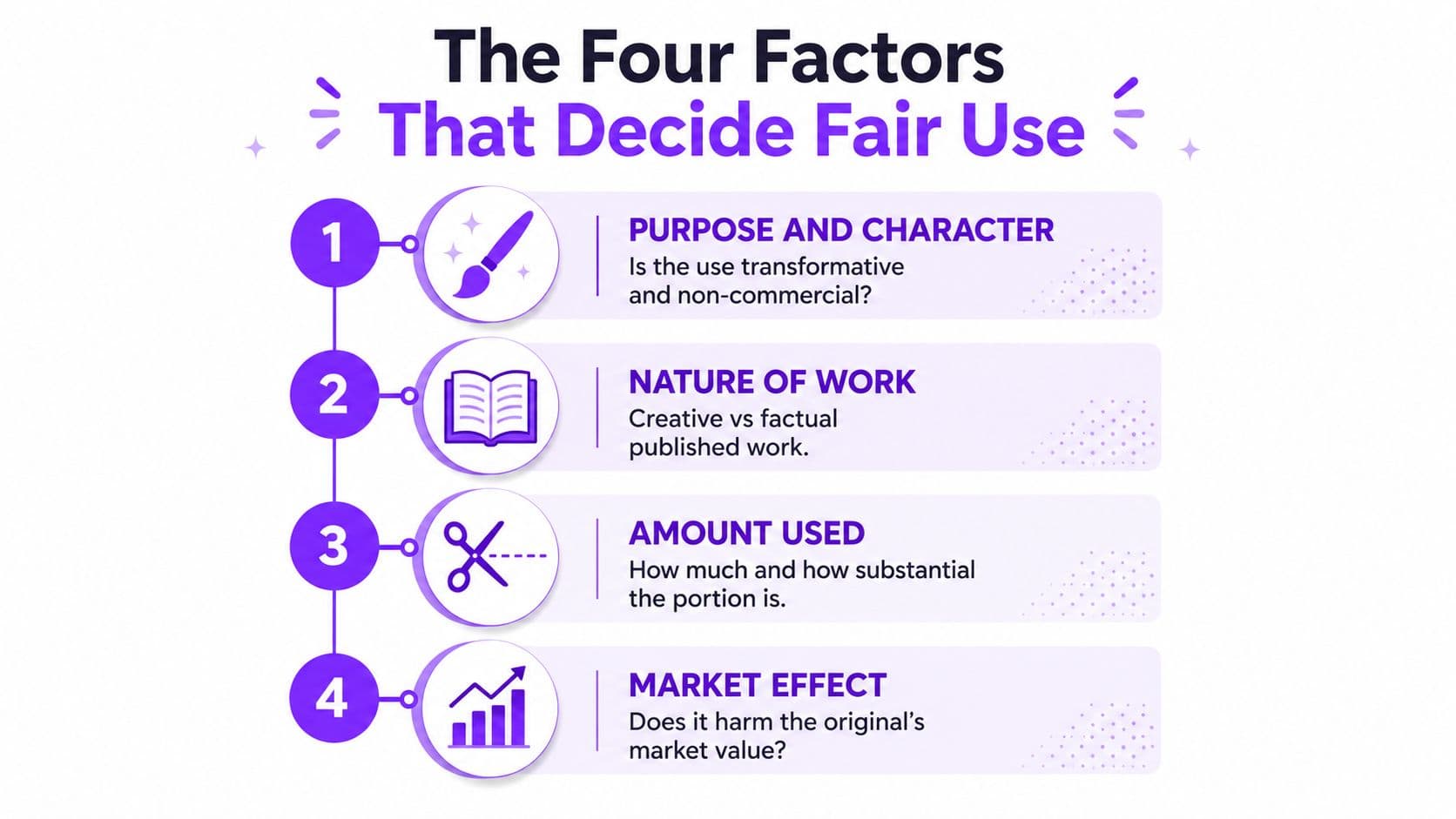
Fair use feels confusing because it isn't a permission slip that activates when a creator checks one box. The Copyright Act of 1976 made the four-factor test the core U.S. framework, covering the purpose and character of the use, the nature of the copyrighted work, the amount taken, and the effect on the original's market (analysis of the statutory framework). Courts weigh those factors together, and they do so case by case.
Practical mindset: Treat fair use as a reasoned legal argument, not as a production setting you can switch on.
This doesn't mean creators should stop experimenting. It means you should design projects with the copyright question in mind. A short lyric excerpt used to examine songwriting may present a different argument from a complete sing-along upload. A parody that comments on the original may differ from a cover presentation that repackages it.
The most useful fair use guidelines therefore do two jobs. They explain the doctrine, and they help you make better creative decisions before you invest time in editing, promotion, and monetization. They also help you respond calmly to a claim, because you'll have a record of what you used, why you used it, and what original value your work adds.
What Fair Use Really Means and How It Works
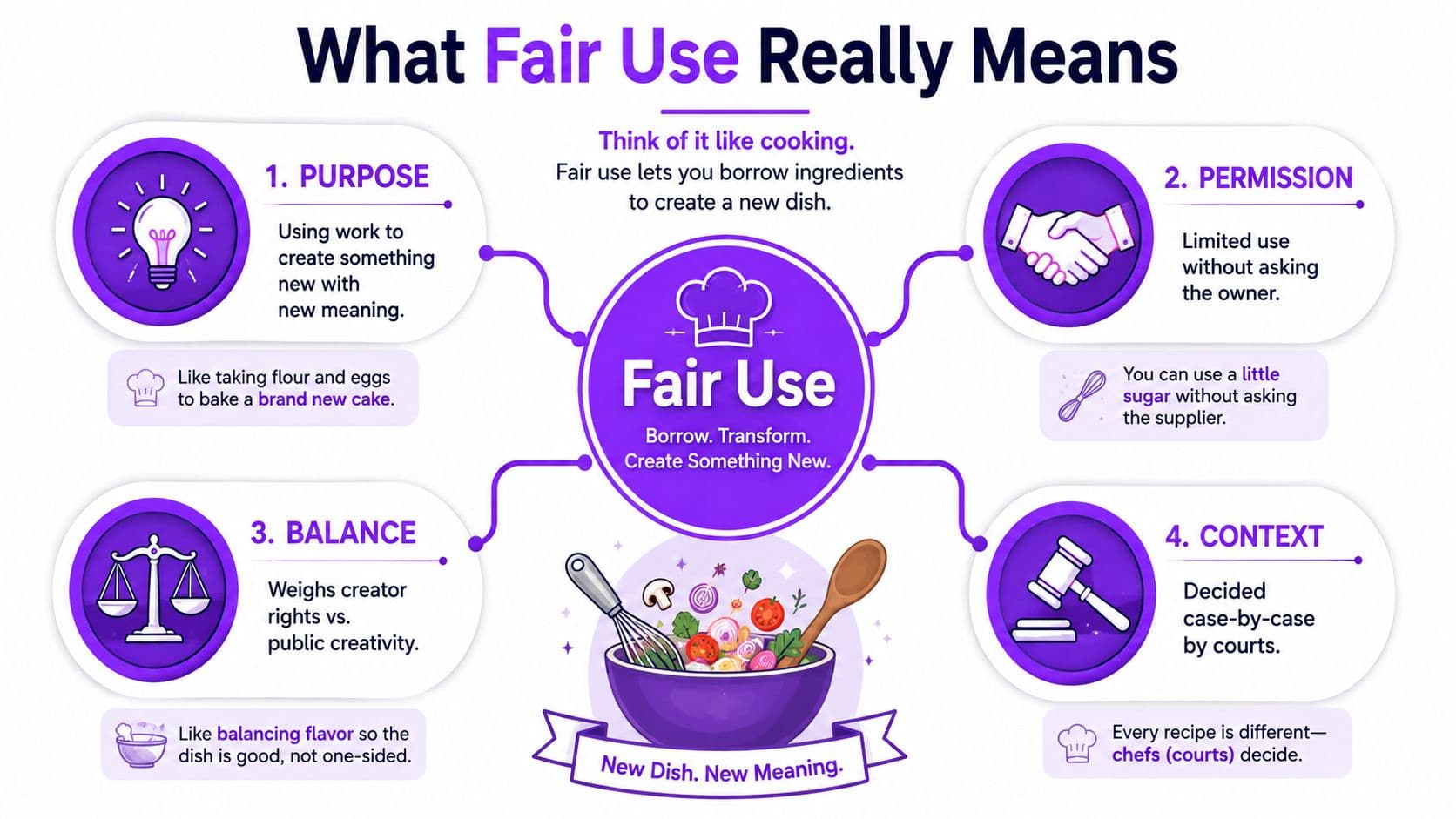
Think of copyrighted material as ingredients in someone else's kitchen. Fair use may let you take a limited ingredient and use it in a new dish, but it doesn't give you permission to serve the entire original meal under your own name. The important question is what your new dish does with the ingredient, not merely whether you changed its presentation.
U.S. fair use can allow limited use without permission for purposes such as criticism, comment, news reporting, teaching, scholarship, and research. The U.S. Copyright Office describes those purposes as illustrative, not automatic safe harbors, and explains that courts apply the four statutory factors rather than a single mechanical rule (U.S. Copyright Office fair use guidance).
Fair use isn't a fixed allowance
Creators often search for a safe number of lyrics, musical notes, seconds, or pages. That shortcut doesn't exist. The modern framework has no fixed safe harbor based on a specific number of words, notes, or a percentage of a work, so a small excerpt can still matter if it contains the work's most recognizable or important part (fair use framework analysis).
The reverse is also true. A larger use doesn't automatically fail in every imaginable context. A critic may need enough material for an audience to understand the point being examined. The purpose, the character of the original, the amount used, and the market consequences all shape the evaluation.
Permission and fair use are different paths
A license is permission from the rights holder. Fair use is a legal doctrine that may provide a defense when a use meets the overall balance of the factors. A creator who believes a use is fair can still face a claim, because platforms and rights holders may evaluate the upload differently from a court.
That uncertainty is why a fair use analysis should be specific. “I gave credit,” “I'm not claiming ownership,” or “this is for entertainment” may explain your intentions, but none of those statements replaces the four-factor analysis. A disclaimer also won't prevent a video from functioning as a substitute for the original.
Fair use protects a context and purpose, not a format. Turning a song into a video doesn't automatically make the underlying copying fair.
The Four Factors That Decide Fair Use
For a karaoke or lyric video, fair use works like four lenses aimed at the same upload. Each lens asks a different question, and the overall assessment depends on how the answers fit together. A favorable answer on one factor cannot erase serious concerns under the others.
Purpose and character
Start with the reason viewers receive the copyrighted material. Are you analyzing the lyrics, commenting on the composition, teaching vocal technique, or presenting the song through a different visual format?
Courts examine whether the new work adds new expression, meaning, message, information, aesthetics, or understanding. Commercial use can weigh against fair use, while commercial status alone does not decide the result. A nonprofit educational project receives no automatic protection either.
For a karaoke video, examine what the editing and visuals contribute. If the upload's main function remains helping viewers sing along with the original song, the first factor presents a serious obstacle. An introduction, custom background, or lyric timing does not change that function by itself.
Nature of the copyrighted work
The second factor concerns the type of material copied. Creative works, including music and lyrics, receive stronger protection interests than factual material. Lyrics may be brief, yet their wording can carry substantial creative value, especially when the copied passage contains the song's most memorable lines.
Ask whether the material appears because viewers need it for explanation or because the expression itself is the attraction. That distinction identifies the copyright interest at stake and helps explain why copying lyrics for singing differs from quoting a factual passage during instruction.
Amount and substantiality
Courts measure both quantity and importance. The analysis asks how much you copied and whether the selection includes the work's most significant or recognizable portion.
A short excerpt supporting a specific criticism has a stronger fair use argument than a complete lyric sequence used for performance. No universal cutoff exists, so removing a few lines does not eliminate risk. Consider whether viewers can receive the song's central expressive experience from your upload without visiting the authorized source.
Market effect
The final factor examines whether the upload affects existing or reasonably foreseeable markets for the copyrighted work and its licensed formats. A full lyric video, karaoke track, or sing-along presentation can compete with licensed lyric, music, or karaoke products, even when the creator adds new backgrounds.
Ask two market questions: does the version substitute for the original video, and could it replace a format the rights holder licenses? The second question matters because copyright owners can develop markets beyond the exact format you copied.
The U.S. Copyright Office's Fair Use Index collects judicial decisions that help creators compare patterns. Past decisions cannot guarantee the result for a new upload. An updated empirical fair use study reviewed 579 opinions across 435 cases from 1978 through 2019 and found fair use in about 40.2% of full-period cases, showing how fact-specific and contested the doctrine remains (empirical fair use study).
Why Format Changes Alone Rarely Qualify as Fair Use
A creator uploads a full song's lyrics over a custom background, adds timed text, and assumes the new design is enough. Viewers can still receive the lyrics in a format made for listening or singing, so the upload may serve much the same function as the copied material.
A filter, animated background, lyric timing, or short introduction can make a video look different without giving the copied work a new purpose or meaning. The first fair use factor focuses on what the new work contributes. Criticism, analysis, parody, instruction, or another distinct message can support a stronger argument, but a changed presentation alone does not settle the question.
A changed purpose also matters only in context. If the new use substitutes for the original recording, lyrics, or a licensed karaoke format, the market may weigh against fair use. Recent Supreme Court guidance stressed that courts should examine the particular use and its relationship to the source market, rather than applying a broad label to every altered version (Supreme Court fair use guidance discussed by Mayer Brown).
Context alone isn't the same as a new purpose
An introduction about the artist supplies context, but it may not change why viewers encounter the song. The copied lyrics remain the central experience, and the added material may be original without changing that function.
For karaoke and lyric creators, ask, “What must the audience learn, understand, or experience from my contribution?” Genuine analysis, a critical structure, or a parody message can give the upload an independent purpose. Decorative changes usually cannot carry that argument by themselves.
A stronger fair use argument changes the audience's reason for encountering the material.
Use only the copied material your commentary or instruction requires. Avoid making the upload a convenient replacement for the original or a licensed format. This approach cannot guarantee fair use, but it connects the creative choices to the factors courts examine.
Real World Examples From Karaoke and Lyric Videos to AI Training
Consider two uploads built from the same song. The first uses a brief lyric excerpt while the creator analyzes its rhyme, imagery, and vocal phrasing. The excerpt appears because the audience needs to understand the analysis. The second displays the complete lyrics in sync with the complete recording so viewers can sing along. The second project may add typography and backgrounds, but its core function remains close to a substitute listening and reading experience.
That contrast is more useful than a simple “short is safe, long is unsafe” rule. A short excerpt can still be problematic if it supplies the central expressive portion, while a longer use may be argued in a critical or educational setting when the amount is necessary for the point. The purpose, amount, and market effect must be assessed together.
Creators who want to pair brief lyrics with social posts can also review practical ideas for using song lyrics for Instagram captions, while remembering that a caption and a public video can involve different amounts, purposes, and market effects.
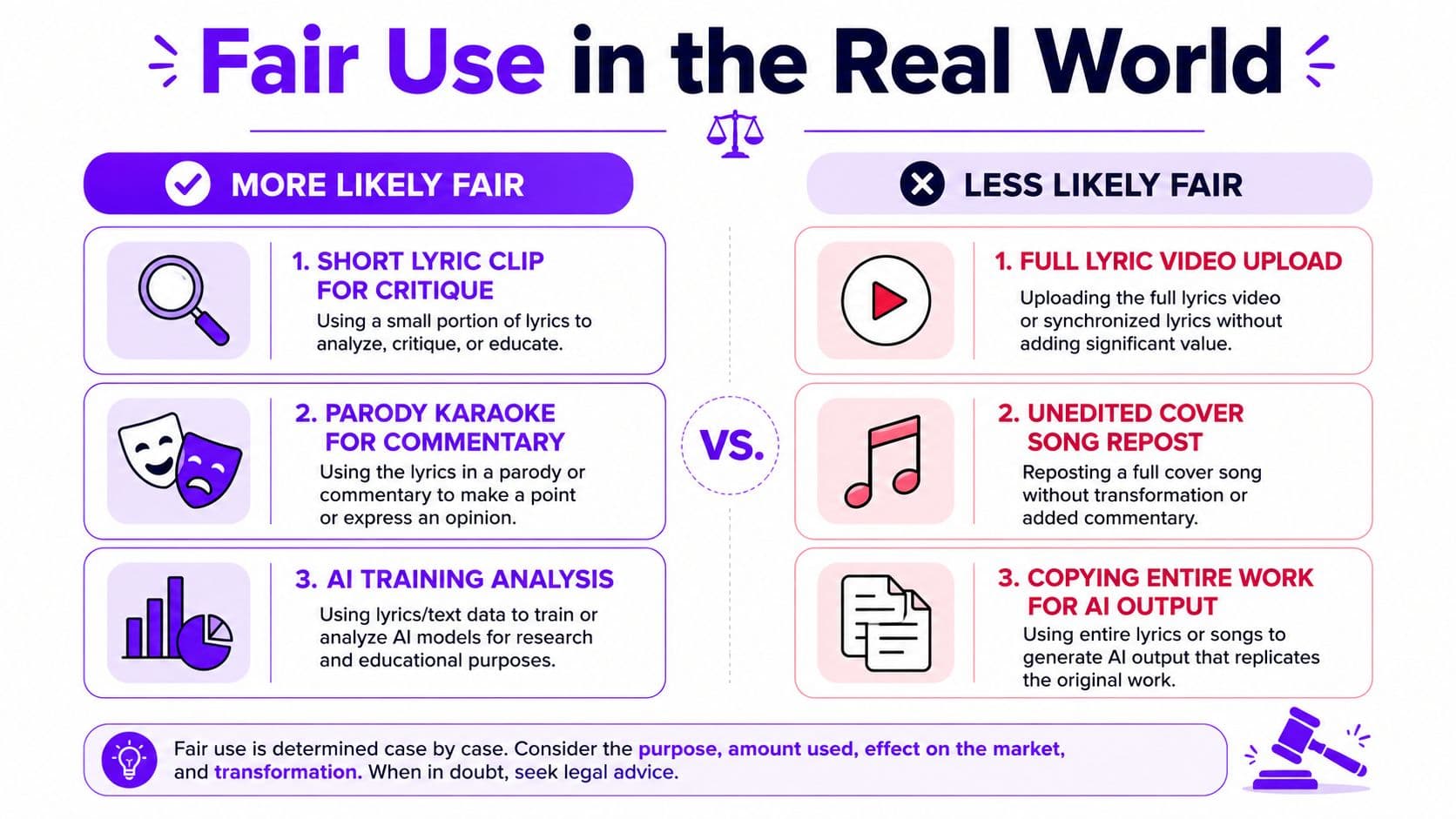
A practical comparison
| Creator project | What to examine |
|---|---|
| Short lyric clip with detailed critique | Whether the excerpt is necessary for analysis and whether the commentary changes the audience's purpose |
| Parody karaoke with a clear message about the original | Whether the work comments on or targets the original, rather than merely borrowing its appeal |
| Full-song lyric video | Whether viewers receive a replacement for an authorized lyric or karaoke experience |
| Unedited cover repost | Whether the upload mainly delivers another performance without a distinct critical, educational, or expressive purpose |
Automated workflows create another boundary question. Lyric syncing, subtitle generation, background customization, and format conversion may begin as technical steps, but the finished upload can become a meaningful adaptation when it reproduces expressive content for public consumption. A browser-based workflow such as the AI lyric video generator from MyKaraoke Video can simplify production, but automation doesn't decide whether the underlying use is lawful.
AI training changes the conversation
AI disputes add a newer version of the same questions. Courts issued the first substantive merits-stage decisions on whether training generative AI systems on copyrighted works can qualify as fair use in 2025, while commentators continued to debate transformation and market substitution (Reuters coverage of AI training rulings).
The practical lesson is restraint. Storing works, training on them, and generating outputs that reproduce lyrics or music-adjacent text can raise different issues. A system's internal use may be argued differently from an output that competes with an existing licensed product, so creators shouldn't assume that “the machine transformed it” settles the analysis.
Your Practical Fair Use Checklist and Risk Reduction Playbook
A karaoke creator discovers a problem after publishing: the video adds attractive visuals, but viewers can still follow the entire song without buying or watching an authorized version. A project record made before export would have exposed that risk earlier. Treat the record like a flight checklist. It cannot guarantee a safe result, but it makes overlooked decisions visible.
Use this sequence before publishing:
- Describe the purpose. Write one sentence explaining what the video contributes. “This teaches viewers how the chorus uses internal rhyme” is clearer than “This is commentary.”
- Mark the copied material. List the recording, lyrics, captions, images, and other elements used. Identify the portions your point requires.
- Reduce the amount. Remove material that does not support the purpose. Editing software makes complete songs and lyric sequences easy to copy, not automatically lawful.
- Test the audience experience. Ask whether viewers could use your upload instead of an authorized original, lyric video, or karaoke product.
- Separate original contributions. Identify your analysis, narration, parody, visuals, performance, or instructional structure. Each should change the viewer's experience, rather than merely decorate copied material.
- Check commercial plans. Review monetization, sponsorship, promotion, and business use, especially when the upload follows an existing market format.
- Save your reasoning. Keep project notes, source details, permissions, licenses, and an export of the final version.
Browser-based editors can help with syncing and customization, but they do not replace rights analysis. If you are preparing source material for karaoke, review the copyright considerations in this guide to downloading songs for karaoke before importing anything.
Context alone does not settle transformation. A creator may add commentary, timing, or visual styling while still delivering the same expressive song experience. The practical question is whether the added material gives viewers a different purpose and experience, or just makes the copied work easier to consume.
Keep the analysis project-specific. Fair use outcomes vary across disputes, so a confident label is not a substitute for documenting purpose, amount, audience substitution, and the work's market. That record also makes later review more precise if a platform claim arrives.
How to Respond to Takedowns and Choose Licensing Alternatives
A takedown or platform claim calls for a calm review, not an immediate argument. Read what material the claimant identified, compare it with your actual upload, and revisit all four factors carefully. If you believe the use is fair, document the purpose, copied amount, original contributions, and market analysis before considering any platform response or counter-notification. Because those actions can carry legal consequences, seek qualified legal advice when the stakes are significant.
If the fair use argument is weak, licensing may be the more sustainable choice. Consider rights-cleared music, direct permission from the relevant rights holders, platform-provided music libraries, or tracks offered under terms that match your intended use. Guidance such as the AIMVG copyright music guide can help you identify permission and attribution questions before production begins.
For creators working with authorized material, a workflow for adding music to a video for YouTube can support the production side, but publishing rights still need separate confirmation. The strongest long-term process pairs creative originality with careful source tracking, clear permissions, and fair use reasoning where permission isn't practical or appropriate.
MyKaraoke Video lets you create karaoke and lyric videos in a browser with automatic lyric syncing, a sync editor, customizable visuals, and modern video exports. Review your song rights first, then visit MyKaraoke Video to build a polished project around material you're authorized to use or a carefully documented fair use purpose.
