You’ve got a title idea, a voice memo full of half-melodies, and a blank page that suddenly feels hostile. That’s a normal place to start. Most lyric problems don’t come from a lack of talent. They come from trying to write the final version before you know what the song is about.
Good lyrics usually arrive through process, not magic. The writers who make it look effortless often have a repeatable workflow for getting from a vague feeling to a singable line. If you want to learn how to write lyrics for a song, stop treating inspiration like a lottery ticket and start treating it like craft.
Finding Your Song's Central Idea
Most beginners start too big. They try to write about heartbreak, freedom, jealousy, or hope. Those aren’t song ideas yet. They’re categories. A lyric gets interesting when you narrow the emotion into a specific moment you can see, hear, and touch.
The fastest way out of that fog is sensory journaling. A Berklee-endorsed approach focuses on a “small moment” and builds from all five senses. In professional workshops, that method had an 85% completion rate to the demo stage, and it also matters for practical delivery because precise 8 to 12 syllables per phrase can boost MyKaraoke Video render accuracy by 40%, according to Berklee’s lyric writing guidance.

Start with one small moment
Don’t journal your whole life story. Pick one scene.
Examples:
- the kitchen after an argument
- a bus stop at midnight
- your hand hovering over a text you shouldn’t send
- the first morning after someone moved out
Then write in plain prose for a few minutes. No rhymes. No pressure to sound profound. Just capture the scene.
Use prompts like these:
- Sight: What’s in the room, on the street, or outside the car window?
- Sound: Is there a fridge humming, traffic passing, a floorboard creaking?
- Touch: What does the air feel like? What are your hands doing?
- Smell: Coffee, rain, cigarette smoke, detergent, stale beer?
- Movement: Are you pacing, frozen, driving, scrolling, packing?
Abstract lines like “I feel alone” rarely hit hard on their own. Concrete lines do the work for you. “Cold coffee on the dresser” tells me more than “I’m sad.”
Practical rule: If your lyric could apply to almost anyone in almost any situation, keep digging.
Turn detail into meaning
Once you’ve got the scene, ask one question: What does this moment mean? Not the whole song. Just the core message.
Maybe the scene means:
- I miss you, but I don’t trust you.
- I’m finally leaving.
- I want to call, but I need to stay silent.
- I’m angry because I still care.
That sentence becomes the seed of your chorus. The scene itself becomes verse material.
If you freeze when generating ideas, outside creative prompts can help. A useful way to shake loose narrative angles is using AI to generate story plots and then stealing the emotional shape, not the wording. Let the prompt suggest situations. Keep the actual lyric language yours.
Build a rough idea bank
Before you write lines, collect fragments in two columns:
| Raw detail | Possible meaning |
|---|---|
| Wet shoes by the door | You came back, but not for me |
| Neon through the blinds | I didn’t sleep at all |
| Unsent message at 2AM | I’m losing the argument with myself |
That table gives you material to pull from later when the song needs a verse image or a chorus phrase.
If you also want to hear how lyric ideas start translating into visual performance, it helps to study examples of music video creation workflows early. Seeing words attached to timing changes how you judge phrasing.
Structuring Your Lyrical Story
A strong image isn’t enough. Plenty of writers have one excellent first verse and no second verse because they never figured out where the story was going. That’s why structure matters.
One of the most useful professional habits is a prose-first workflow. A 7-step songwriting methodology emphasizes writing the full story in non-rhyming prose before polishing lyrics. Skipping that step leads to mid-song stagnation in about 70% of amateur attempts, while clients who follow the full process report a 5x higher placement rate in submissions to major markets, according to this songwriting breakdown.
Write the song as a short letter first
Before rhyme, write 2 to 3 sentences that explain the whole song in everyday language.
For example:
I saw your jacket still hanging by the door and realized I’d been pretending the breakup wasn’t real. I spent the whole night deciding whether to call, but by morning I knew silence was the answer. The song ends with acceptance, not reunion.
That little paragraph already gives you a shape:
- beginning, denial
- middle, conflict
- end, decision
Now your verses and chorus have jobs.
Give each section a function
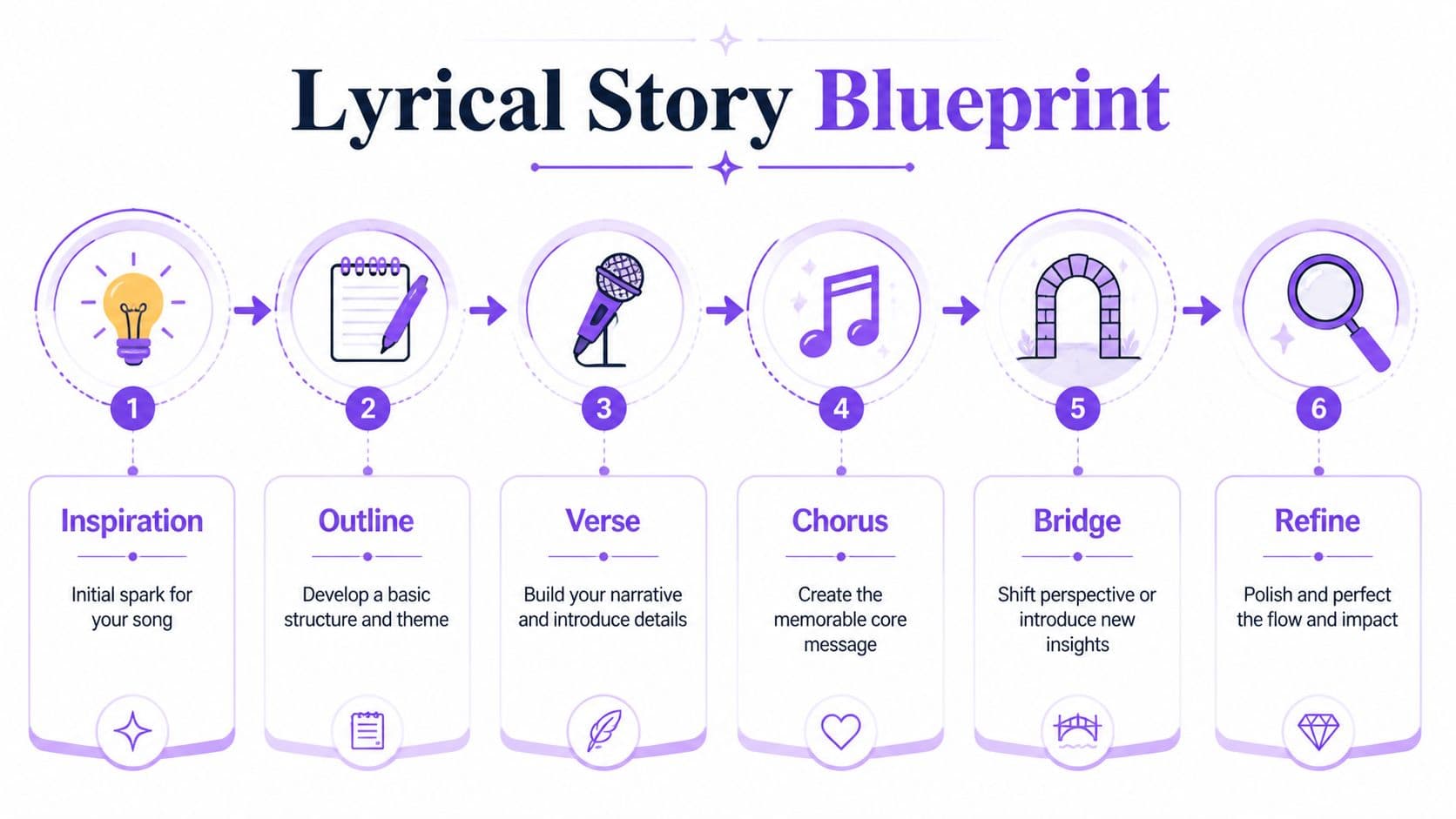
A common pop structure is Verse, Chorus, Verse, Chorus, Bridge, Chorus. Don’t fill those sections randomly. Assign each one a purpose.
- Verse 1: Set the scene. Put the listener somewhere.
- Chorus: State the emotional truth or hook.
- Verse 2: Add pressure, contrast, or a new detail that deepens the story.
- Bridge: Shift perspective. Admit what the verses avoided.
- Final chorus: Return to the hook with more weight.
Writers often waste Verse 2 by repeating Verse 1 with different nouns. If the first verse shows the problem, the second should complicate it.
A simple mapping tool
Use this quick blueprint before drafting lyrics:
| Song part | Question to answer |
|---|---|
| Verse 1 | What happened? |
| Chorus | Why does it matter? |
| Verse 2 | What makes it worse, clearer, or more urgent? |
| Bridge | What truth have I avoided saying? |
That keeps the narrative moving.
A chorus can repeat. A verse has to earn its space.
Borrow melody discipline before you write final lines
The same 7-step process begins in a way many new writers resist. Sing a simple nursery rhyme melody while scribbling prose. That sounds childish until you try it. It removes the pressure to be clever and lets you discover rhythm before rhyme.
A practical version looks like this:
- Hum or sing a familiar simple melody.
- Speak your prose story over it.
- Circle phrases that naturally fall into place.
- Keep the phrases that sound conversational.
- Save the polished rhymes for later.
Another useful guideline from that methodology is to make your chorus highly repetitive for memorability. Repetition isn’t laziness when it’s attached to the right emotional hook. It’s how listeners remember the song after one pass.
Mastering Rhyme Meter and Phrasing
Weak lyrics usually don’t fail because the idea is bad. They fail because the lines fight the mouth. You can feel it when you sing them. Too many syllables. Stress on the wrong word. A rhyme that sounds forced. A phrase that reads well but won’t land on beat.
That’s where craft takes over.
Use rhyme as control, not decoration
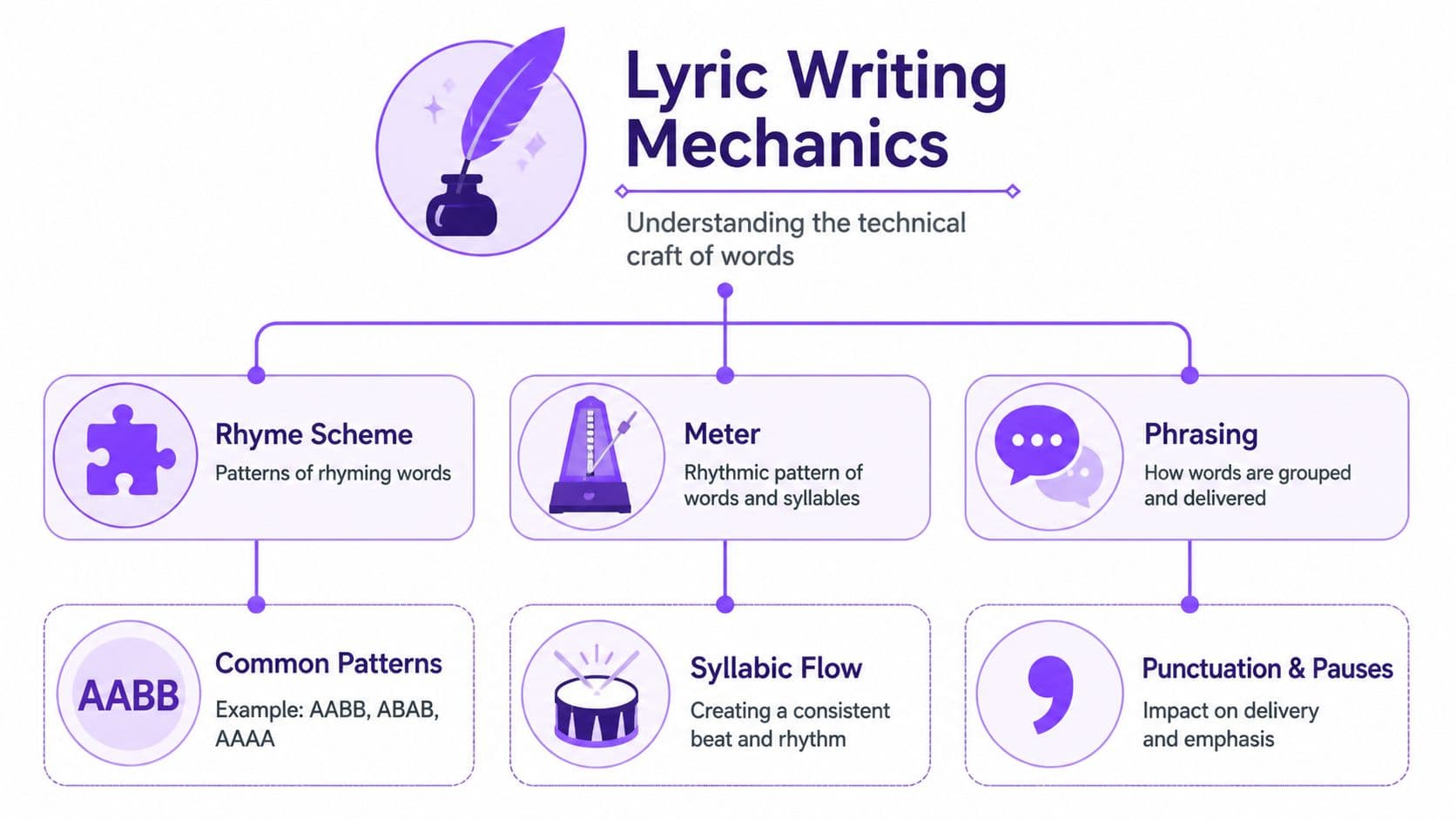
New writers often chase rhyme too early and end up writing around the dictionary instead of the emotion. The result sounds polished but hollow. Write the thought first. Then choose the rhyme type that supports the feel of the song.
Three useful rhyme modes:
- Perfect rhymeClean, stable, memorable. Good for hooks and direct statements.
- Near rhymeLooser and more conversational. Good when perfect rhyme sounds too neat for the emotion.
- Internal rhymeAdds momentum inside a line. Useful in faster phrasing or dense verses.
Here’s the trade-off:
| Technique | What it does well | Where it goes wrong |
|---|---|---|
| Perfect rhyme | Makes lines feel resolved | Can sound predictable |
| Near rhyme | Feels natural and modern | Can sound sloppy if overused |
| Internal rhyme | Adds movement and texture | Can clutter a simple idea |
If the song is intimate, you usually want less verbal showing off. If it’s rhythmic and punchy, internal rhymes can create lift.
Meter is the hidden difference between readable and singable
Meter is just the pattern of stresses and syllables. You don’t need to talk about it like a poetry professor. You do need to hear it.
Say these two lines aloud:
- “I waited by the hallway light”
- “I was waiting by the little hallway light”
They mean roughly the same thing. Only one is likely to sit cleanly in a melody.
A useful default is to aim for speech that naturally leans into alternating weak and strong stresses. Many writers call that iambic movement. The label matters less than the result. The line should feel like something a person could sing without wrestling it.
Check phrasing with a mouth test
Before deciding a lyric is done, do this:
- Speak it in rhythm: Don’t sing yet. If you stumble while speaking it, the line probably needs trimming.
- Mark the stressed syllables: If the musical accent lands on the wrong syllable, rewrite the line.
- Watch conjunction clutter: Too many “and,” “that,” “just,” or “really” words usually signal padding.
- Cut one word per line: Most drafts improve when you remove the obvious support words.
If a line only works because you’re bending pronunciation to save the rhyme, it doesn’t work.
Phrasing shapes emotion
Phrasing isn’t only about fit. It changes meaning.
A short line can feel blunt:
- “Don’t come back.”
A longer line can feel conflicted:
- “Don’t come back unless you mean it this time.”
Same subject. Different emotional temperature.
When learning how to write lyrics for a song, pay attention to how long your thought needs to breathe. Sharp phrases suit anger, confidence, and hooks. Longer phrases often suit memory, regret, and narrative detail.
One practical habit helps more than almost anything else. Print the lyric or put it on a screen without the music and mark where you naturally pause. Those pauses often reveal where your line breaks should go, where a melody wants space, and where a phrase is trying to say too much at once.
Weaving Words with Melody
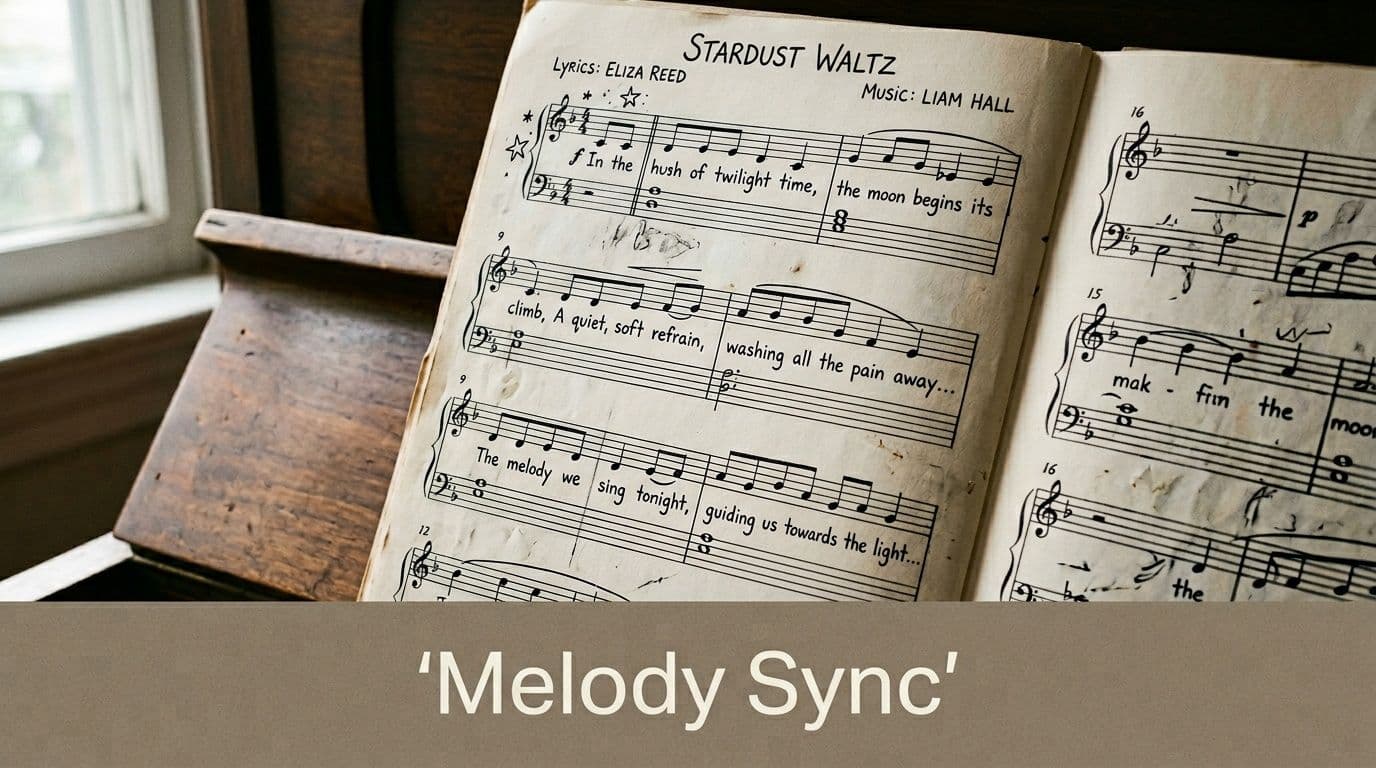
Lyrics on a page are unfinished. They become songs when melody gives them gravity, tension, and release. A line that looks ordinary in a notebook can become unforgettable when the right note carries the right word.
If the melody comes first
This is common. You mumble vowel sounds over chords, and suddenly there’s a contour that feels like a chorus. When that happens, don’t force complete sentences too early. Start by hearing the shape.
Ask:
- Where does the melody rise?
- Which note is held the longest?
- Where does the phrase need a hard consonant or an open vowel?
The highest or longest note usually deserves your most important word. If your emotional peak lands on a throwaway word like “the” or “and,” the line is wasting musical energy.
A melody also tells you how dense the lyric can be. Fast moving notes can carry more language. Long held notes need simpler words and clearer vowels.
If the lyric comes first
Sometimes you’ve already written a strong verse in prose-like lines. Then the job is compression. You’re not setting text to music so much as discovering which parts of the text want to be sung.
Try this comparison:
| Lyric issue | Musical fix |
|---|---|
| Too many syllables | Cut helper words and repeated ideas |
| Important word feels weak | Move it to the strong beat or longer note |
| Line feels monotone | Split it into two phrases with contrast |
| Chorus lacks lift | Reserve a wider melodic jump for the hook |
If you build tracks yourself, it helps to understand how arrangement affects lyric placement. Studying different backing track software options can sharpen your sense of where vocal space exists and where the instrumental is already doing too much.
The line must sound like speech and song
A good lyric sits in the overlap. Too speech-like, and it can feel flat. Too literary, and it can become stiff. Melody lets you cheat that line a little, but not much.
Listen for these friction points:
- a stressed note on an unstressed syllable
- a long note on a clunky word
- too many consonants in a quick run
- a phrase that needs breath where the music gives none
This walkthrough is worth watching because you can hear how lyric and melody lock together in practice:
One more habit separates solid writers from frustrated ones. Record rough takes early. Your mouth will expose problems your eyes forgive. If a line feels clever but awkward when sung, trust the sung version.
Revising and Polishing Your Lyrics
First drafts feel precious because they’re hard-won. That doesn’t make them good. Revision is where songs stop sounding like diary entries and start sounding finished.
The mistake is thinking editing means sanding off emotion. Good editing does the opposite. It removes the parts that block the emotion from reaching the listener.
Cut what you love if it weakens the song
A beautiful line can still be the wrong line. If it pulls attention away from the hook, confuses the narrative, or shifts the voice of the song, cut it.
Use this test on every section:
- Does this line sound like the same person speaking?
- Does it move the story or deepen the hook?
- Would the song lose anything real if I removed it?
If the answer to that last question is no, delete it.
Some lines are good writing and bad songwriting. Know the difference.
Hunt clichés with a cold eye
Certain phrases arrive because they’re available, not because they’re true. “Broken heart.” “Dark night.” “Set me free.” “Lost without you.” These aren’t unusable, but they’re often placeholders for a more exact image.
Swap the generic phrase for what happened.
Instead of:
- my heart is broken
Try:
- I kept your key on my ring for three more weeks
The second line gives the listener something to hold. It also tells us more about the character.
Use AI like an assistant, not a ghostwriter
Modern workflow offers advantages, if used carefully. According to this review of lyric writing and AI tools, AI-assisted songwriting adoption grew 320% in the last year, but a Songwriters Guild study found 68% of purely AI-generated lyrics were rated “uninspired.” The same source notes that the strongest results come from using AI for structure and iterative refinement while keeping the human-written unique moments, with internal MyKaraoke user tests in 2026 reporting a 40% boost in output quality from that approach.
That lines up with what many working writers already suspect. AI is useful for:
- finding alternate rhyme families
- shortening clumsy lines
- generating contrast for a second verse
- offering ten bad options so one good revision occurs to you
It’s weak at producing lived detail. It doesn’t know what your apartment smelled like after the rain, or the exact sentence someone used that kept echoing in your head. That part is still your job.
A practical split works well:
- let AI help with structure
- keep the specific memory, image, and point of view human
Revision pass checklist
Don’t edit everything at once. Make separate passes.
| Revision pass | What to look for |
|---|---|
| Meaning pass | Is the song saying one clear thing? |
| Image pass | Are the verses concrete enough to see? |
| Singability pass | Do the syllables and stresses land cleanly? |
| Hook pass | Is the chorus simple enough to remember? |
When a lyric still feels off, strip it back to prose again. That usually reveals whether the problem is wording, structure, or honesty.
Bringing Your Lyrics to Life with Video
A lyric isn’t fully tested until it’s been experienced in time. On the page, almost anything can seem smooth. Once the words move against real audio, weak spots show up fast. You hear where the phrase arrives late, where a line is too crowded, and where the chorus doesn’t hit as hard as you thought.
That’s why a lyric video isn’t just promotion. It’s a diagnostic tool.

Why visual sync exposes bad writing
When lyrics appear line by line on screen, timing becomes obvious. You notice:
- lines that are too long for the musical phrase
- awkward pauses that looked fine in text
- repeated words that help the hook, or hurt it
- verse sections that lose momentum
This is especially useful if you write by instinct and tend to revise by ear. The screen gives you another layer of truth. If the words feel late, cramped, or emotionally flat in sync, the song probably needs another pass.
If you want a broader look at current AI tools for lyric videos, that comparison is useful for understanding what automation can speed up and what still needs your judgment.
Use video as a final proofread
A smart finishing workflow looks like this:
- Export a rough audio mix.
- Paste in the current lyric draft.
- Watch the full song once without editing.
- Mark every moment that feels rushed, confusing, or underwhelming.
- Revise the lyric, not just the sync.
This is also the stage where formatting choices matter. Line breaks can change how a listener understands the phrase. A lyric that works as one line may hit harder when split into two.
If you’re preparing a release, it also helps to learn the practical side of adding lyrics to songs for synced video output. That workflow forces you to confront whether your phrasing is clean enough for an audience to follow.
The main point is simple. If you want to know how to write lyrics for a song that people can feel, don’t stop at the notebook. Hear it, sing it, sync it, watch it. The final draft usually reveals itself there.
If you’re ready to test your finished lyrics against real timing and turn them into a polished lyric or karaoke video, MyKaraoke Video makes that step fast. Upload your song, paste your lyrics, sync them in the browser, and use the result as both a shareable video and a final proofread of your writing.