Going viral isn't about getting lucky. It’s about understanding what makes people tick. The secret is creating something that hits one of three core triggers: it sparks a strong emotion, provides real-world practical value, or gives people a bit of social currency to spend. Once you get that, you stop guessing and start creating with a purpose.
Understanding the Psychology of Why People Share
Before you even think about hitting record, you need to get inside the head of your audience and figure out why they would share something. Virality is almost never an accident. It’s engineered from the very beginning by tapping into basic human motivations. To really get a handle on this, you should check out the real strategies behind shareable content.
Most content dies a quiet death not because of some mysterious algorithm, but because it fails to make anyone feel anything. It just exists. But top creators know a share is a statement. People share content that says something about who they are, what they believe in, or what tribe they belong to.
The Emotional Connection
Emotion is the rocket fuel for anything that goes viral. Content that triggers high-energy emotions—whether it's joy or even anger—gets shared far more often. Think about the last video that made you genuinely laugh until you cried, or a story that gave you goosebumps. That powerful feeling creates an instant impulse to share it with someone else.
Here are a few emotional triggers that work like a charm:
- Awe and Inspiration: Videos of incredible skill, stunning natural beauty, or people doing amazing things for each other make us feel good and we want to pass that feeling along.
- Humor: Nothing connects people faster than a shared laugh. A truly funny meme or a relatable skit is an easy, instant gift of happiness you can send to a friend.
- Anger and Outrage: This one is a bit of a double-edged sword, but content that points out a clear injustice can spread like wildfire. People share it to say, "This is not okay!" and find others who agree.
The Power of Utility
It's not always about feelings. Sometimes, pure usefulness is all it takes. People absolutely love to share things that solve a problem, teach a new skill, or offer a clever shortcut. When they do, it makes them look like the smart, helpful friend in their group.
A perfect example is a quick tutorial showing a kitchen hack or a simple tech tip. The value is immediate, clear, and easy to pass on. It’s a no-brainer share.
Key Takeaway: If your content makes someone's life easier or makes them look smarter, they won't just consume it—they'll become your biggest advocates. They share it because it helps them help their own friends.
Gaining Social Currency
Finally, people share things that make them look good. This is what we call social currency. When you share something clever, exclusive, or ahead-of-the-curve, you elevate your own status. You become the person who is "in the know."
Think about content that reveals a hidden feature in a popular app or an insider's travel tip. Sharing that information makes the person feel like they're giving their friends a valuable secret. Your goal is to create content that gives your audience this currency to spend. You're not just giving them a video; you're giving them a tool to build their own reputation.
To put it all together, successful viral content almost always leans heavily on one of these three psychological pillars.
The Three Pillars of Viral Content
| Pillar | Description | Example Application |
|---|---|---|
| Emotion | Content that triggers a high-arousal feeling like awe, laughter, inspiration, or even anger. | A karaoke video of an emotional ballad that tells a powerful story, making viewers feel moved. |
| Utility | Content that provides practical, actionable value that helps solve a problem or teaches a skill. | A tutorial showing a breathing technique for singers to hit high notes, presented in a lyric video format. |
| Social Currency | Content that makes the sharer look smart, cool, or in-the-know to their social circle. | A video breaking down the "secret" meaning behind a famous song's lyrics, giving viewers an "aha!" moment to share. |
By building your ideas around these core human drivers, you stop creating content and start creating experiences that people feel compelled to share.
Finding Your Next Viral Idea

The most brilliant content always feels like a stroke of genius, but it’s rarely pulled from thin air. The truth is, the best ideas live at the intersection of what your audience is already talking about and a perspective that only you can bring. This isn't about guesswork; it's a mix of strategic listening and a dash of creative alchemy.
Viral content doesn't create a conversation—it joins one that’s already happening. Your job is to find that conversational current before it turns into an oversaturated tidal wave. That means getting good at listening to what’s bubbling up online.
Tune into Trending Conversations
The very first step is to become a master listener. And I don't mean just scrolling through your feed. Social listening is about actively monitoring platforms to understand what's capturing people's attention right now. You’re looking for patterns—in sounds, video formats, and topics—that are hitting a nerve with your target audience.
Think of it this way: if you wanted to write a hit song, you wouldn't completely ignore what's on the radio. You'd listen, learn the structure of what works, and then inject your own style. The same exact principle applies here.
Here’s how to listen with purpose:
- Monitor Trending Audio: Keep a close eye on the sounds and songs popping off on platforms like TikTok and Instagram Reels. Often, a single audio clip is the catalyst for a massive trend or challenge.
- Identify Popular Formats: Watch for recurring video structures. Is everyone doing a "day in the life" montage, a "top 5 list," or a certain type of reaction video? These formats give you a familiar framework to plug your own message into.
- Track Niche Hashtags: Go deeper than the big, generic trending topics. What hashtags is your community using? What inside jokes are they making? This is where the real gold is hidden.
Analyze Competitors for Audience Needs
Looking at what your competitors are doing is smart. Mindlessly copying them is a recipe for failure. Instead of asking, "What did they post?" you need to be asking, "What audience need did this content actually solve?" This question gets you to the strategy behind the content.
For example, a competitor’s video about a simple productivity hack goes viral. The surface-level takeaway is "productivity hacks are popular." But the real need being met was likely a feeling of being completely overwhelmed and wanting a tiny, easy win to feel in control again.
When you look at competitor content, don't just see the video—see the problem it solved for the viewer. Your goal isn't to remake their video. It's to find a newer, better way to solve that same core problem for your audience.
This way of thinking frees you up. You can address the same proven audience desire without ever looking like a copycat. Now you can brainstorm other ways to help an overwhelmed audience—maybe a video on a 5-minute meditation, a quick tutorial for a scheduling app, or even a relatable comedy sketch about procrastination. The topic is different, but you're still hitting that same powerful emotional trigger.
Use AI to Brainstorm Unique Angles
Okay, so you've found a trend and you understand the underlying audience need. Now it’s time to find your unique spin. This is where AI brainstorming tools can be an absolute game-changer. The key is to stop asking for generic "viral ideas" and start feeding the AI specific, layered prompts.
A powerful prompt combines the trend, your audience, and your brand's personality. Here’s a little template I use that you can adapt:
"Act as a social media strategist for a brand that helps [your audience, e.g., aspiring musicians]. There's a current trend using [trending audio/format, e.g., the 'unspoken rules' format]. Brainstorm 5 unique video ideas that connect this trend to the core desire of [audience need, e.g., overcoming stage fright]. The tone should be [your brand voice, e.g., empathetic and inspiring]."
This prompt forces the AI to move beyond generic fluff and give you concepts that are actually strategic. You're combining the timeliness of a trend with the timeless appeal of solving a real human problem, putting you in the perfect spot to create something that truly connects.
Crafting Hooks and Stories That Captivate
You’ve got about three seconds to stop a thumb. Seriously, that's it. In the endless scroll of a social media feed, your opening isn't just important—it's the only thing that matters. A killer hook is the bouncer at the door of your content; without it, your brilliant story is left out in the cold.
This is non-negotiable, especially with video. Video isn't just king anymore; it's the whole kingdom. It drives a staggering 71% of all online traffic and is far and away the most-devoured format out there. And it's not just any video—vertical formats like YouTube Shorts and Instagram Reels have 1.8x higher completion rates than their horizontal cousins. They're built for that split-second attention grab.
Mastering the Art of the Three-Second Hook
So, what makes a great hook? It’s not some elaborate cinematic opening. It’s a sharp question, a visually jarring shot, or a bold statement that makes someone physically stop and think, "Wait, what was that?" You're creating an instant curiosity gap they just have to see filled.
Here are three hook formulas I've seen work time and time again:
- The Bold Claim: Kick things off with something provocative or counterintuitive. A video that opens with the text, "Most viral content flops because it wasn't designed to be shared," immediately challenges what people think they know. They'll stick around to hear you prove it.
- The Visual Surprise: Your first frame needs to be weird. Think of a sudden cut, a bizarre camera angle, or a beautiful scene that feels completely out of context. This pattern interruption is your best friend—it shatters the mindless scrolling and buys you a few precious seconds.
- The Relatable Problem: Start by calling out a pain point your audience knows all too well. An opener like, "Here's the real reason you keep running out of content ideas," speaks directly to creators hitting that wall. They feel understood and are desperate for your solution.
Pro Tip: Never, ever bury the lead. The most interesting, shocking, or valuable piece of your content needs to show up, in some form, within the first three seconds. Save the slow, dramatic build-up for a feature film.
Weaving Narratives in a Short-Form World
Once the hook has done its job, the story has to take the wheel. Storytelling in a 30-second clip isn't about deep plots and character development. It’s about a simple, satisfying emotional arc. Even the shortest video needs a beginning, a middle, and an end to feel whole.
Think of it like this:
- Beginning (The Hook): Here’s the problem or the question.
- Middle (The Journey): Here’s the messy part, the process, the attempt to fix it.
- End (The Resolution): Here’s the final result, the answer, the transformation.
This simple framework turns a random video into a story that actually holds someone's attention. To get more ideas on this, you can check out our guide on how to create engaging social media content.
Using MyKaraoke Video to Tell Lyrical Stories
This is where a tool like MyKaraoke Video can be your secret weapon. A song is already a self-contained story. Your job is to turn up the volume on that story with visual cues. You're not just slapping words on a screen; you're directing an emotional journey.
Let's say you're making a lyric video for a powerful, uplifting anthem. Here’s how you could use storytelling principles to make it pop:
- Font Choice: Use a weak, thin font for the verses describing the struggle. Then, for the chorus, have the font switch to something bold and strong. You're visually showing the shift from doubt to confidence.
- Dynamic Animations: Make the lyrics for a sad line fade in slowly and gracefully. For an explosive, happy line, have the words burst onto the screen with energy. The timing and style of your animations dictate the emotional pace.
- Background Visuals: Start with a dark, moody background. As the song builds to its climax, transition the background to something bright and vibrant, mirroring the song's own narrative arc.
When you start thinking this way, you're transforming a passive listening experience into an active, engaging one. Every line of the song becomes a tiny scene in your mini-movie, creating something that feels far more memorable and shareable.
Your Production Playbook for High-Impact Video
Having a great idea is only half the battle. Where most creators stumble is in the execution. The good news? The gap between a slick, professional-looking video and something you can make at home has basically vanished. The secret isn't a Hollywood budget; it's a smart production workflow that respects your audience's time.
Think about it: perceived quality directly influences how much trust someone puts in your content and how long they'll stick around. A polished video sends a clear signal that what you've made is valuable. This doesn't require a film crew, just attention to the details that really matter.
Creating Viral Lyric Videos with MyKaraoke Video
This is where tools like MyKaraoke Video come in. They’re designed to handle all the technical heavy lifting, freeing you up to focus on the creative side of things—the part that actually connects with people. You can whip up a dynamic, shareable lyric video from any song in just a few minutes, not hours. It's all about working smarter.
The whole process is incredibly straightforward. You kick things off by uploading your audio file and pasting in the lyrics. That simple first step replaces what used to be a mind-numbing manual task, putting you on the fast track right away.
The interface gives you a real-time preview, so you can see your creative choices instantly without getting bogged down by slow rendering times.
From there, the platform's AI handles the lyric syncing, automatically timing the text to the music. You still have full control, of course. You can jump into the sync editor to fine-tune every single word, making sure it lands with perfect timing for that emotional punch.
A Quick Tip from Experience: Virality is so often about emotional pacing. When you can control the exact moment a powerful lyric flashes on screen, you can build anticipation and create those "aha!" moments that make people smash the share button.
Customizing for Today's Trends and Aesthetics
To make sure your video feels fresh and relevant, you have to get the visuals right. That means aligning your video's look with the aesthetic trends blowing up on platforms like TikTok and Instagram. It’s a subtle way of showing your audience that you get the culture.
MyKaraoke Video gives you a full suite of options to nail the vibe:
- Font Selection: Pick fonts that match the song’s mood. Are you going for an elegant serif for a slow ballad or a bold, in-your-face sans-serif for a hype track?
- Color Palettes: Use color to create a feeling. Muted, earthy tones can feel calming and authentic, while bright neons can generate excitement and energy.
- Backgrounds: Don't settle for a black screen. Upload your own custom images or video clips to add context and visual texture that helps tell the song's story.
This simple creative process is the engine behind viewer engagement.
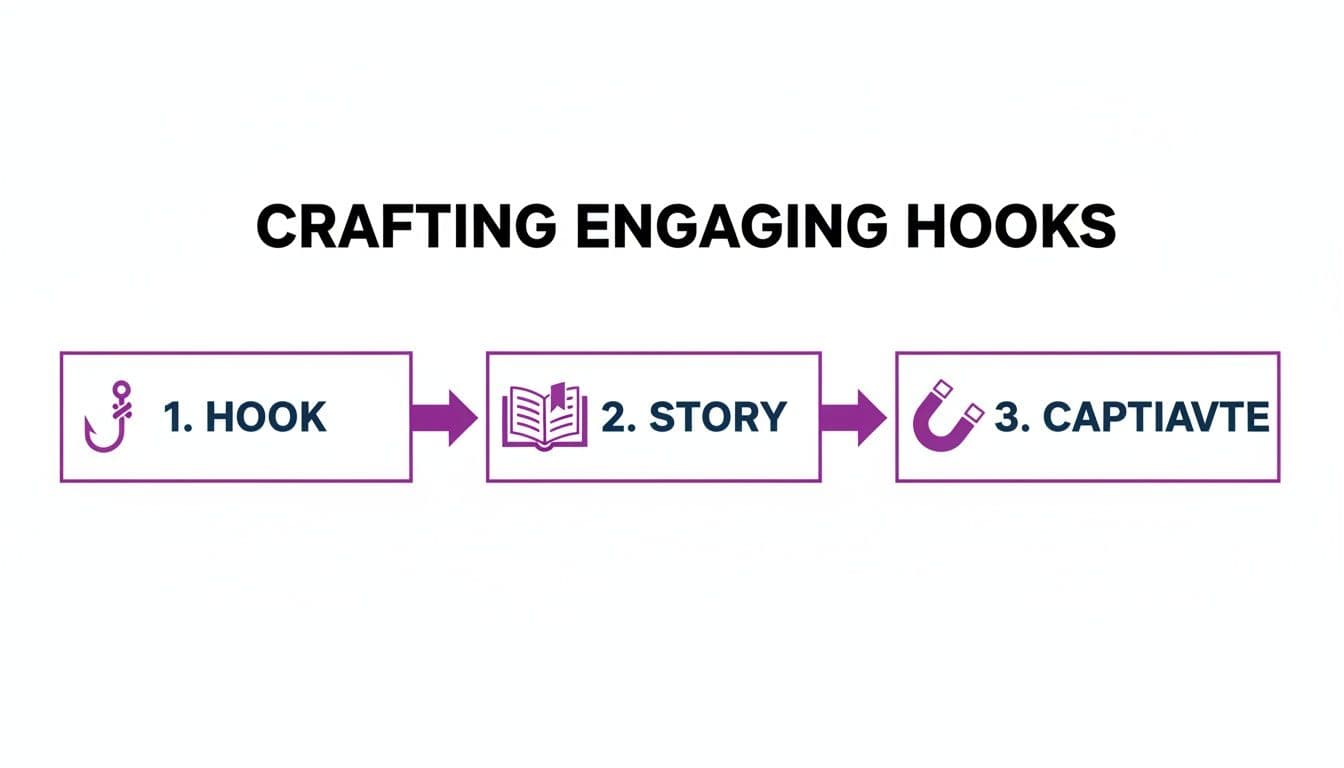
This flow—hook, story, captivate—is the core of any great piece of content, and a well-produced lyric video is no exception. For a deeper dive, check out our complete guide on how to create viral videos.
The Pre-Publication Quality Checklist
Before you even think about hitting "post," a final quality check is non-negotiable. This isn't about chasing perfection; it's about eliminating any small technical glitch that could make someone mindlessly scroll past. One tiny flaw can break the spell you've worked so hard to create.
Run every single video through this quick but critical checklist.
- Resolution Check (1080p Minimum): Is the video exported in high definition? Grainy, pixelated content just screams "amateur." A sharp 1080p resolution is the bare minimum standard these days.
- Aspect Ratio Verification (9:16 for Vertical): Does the video fit the platform? For TikTok, Reels, and Shorts, a 9:16 vertical aspect ratio is a must. It fills the whole screen and makes the experience far more immersive.
- Audio Quality Audit: Seriously, put on headphones and listen to the final export. Is the audio clean? Any weird background noise, clipping, or distortion is an instant turn-off for viewers.
- Safe Zone Confirmation: Are your key visuals and text within the "safe zones"? You need to make sure the platform's own UI—usernames, captions, like buttons—isn't covering up your perfectly timed lyrics.
- Caption and Subtitle Review: If you added your own captions, read them one last time. Typos or bad timing can kill your credibility and make your content inaccessible to a huge chunk of potential viewers.
This checklist only takes a few minutes, but it can make a world of difference in your video's performance. It’s that final layer of polish that separates amateur content from videos that are truly ready to take off.
Getting Your Content Seen: How to Amplify Your Reach

Here's a tough pill to swallow: creating a masterpiece means nothing if no one sees it. In the game of viral content, the video itself is just your ticket to enter. The real MVPs are strategic distribution and smart amplification.
Posting and praying is a recipe for getting lost in the noise. You have to be proactive. A modern amplification strategy isn't about one big launch; it's about building consistent momentum that signals to the algorithms that your content is worth showing to more people.
Feed the Algorithm: The New Rules of Volume
The biggest change we've seen in recent years is how hungry the algorithms have become. Platforms like TikTok and Instagram now heavily reward creators who show up consistently. While that might sound exhausting, it's actually a huge advantage—it gives you more chances to test, learn, and figure out what works.
The data is pretty clear: to properly feed social algorithms, brands often need to churn out between 48-72 posts a week across all their platforms. For anyone using MyKaraoke Video to make lyric videos—musicians, marketers, you name it—this means you need a system to create customized content quickly and efficiently.
This isn't about choosing quantity over quality. It’s about building a workflow that lets you maintain a steady stream of high-quality, relevant videos that keep your audience hooked and the algorithm happy. For a deeper dive, check out our guide on building a powerful video content marketing strategy.
The First Hour is Golden: Fan the Flames in the Comments
The first 60 minutes after you post are absolutely critical. This is when the platform decides if your content has legs. One of the strongest signals it looks for is immediate engagement, especially in the comments section.
Your job doesn't end when you hit "publish." You need to be an active participant in the conversation you just started.
Key Insight: Think of your comments section as a live focus group. The questions, jokes, and debates happening there are pure gold for future content ideas and a direct line to what your audience actually cares about.
Here’s how to make that first hour count:
- Be a Rapid Responder: Try to reply to every single comment within that first hour. Each reply you leave literally doubles your engagement count and shows the algorithm that your post is sparking a real discussion.
- Ask Questions: Don’t just drop a "thanks!" and move on. Ask open-ended questions in your replies to keep the conversation rolling. Something as simple as, "That's a great point, what's your take on...?" can turn a single comment into a long, valuable thread.
- Pin a Provocative Comment: Find a comment that’s interesting, funny, or even a little controversial and pin it to the top. This acts as a prompt, encouraging others to jump in with their own opinions.
Work Smarter, Not Harder: Collaborating with Micro-Influencers
Throwing a huge budget at a big-name influencer can feel inauthentic and often falls flat. The real power today is with micro-influencers—creators with smaller, but hyper-engaged, niche audiences. A recommendation from someone your audience already knows and trusts is worth far more than a flashy, generic ad.
The trick is to find partners whose audience is a genuine match for yours. Look for creators who are already talking about topics related to your content. For a lyric video, that could be a vocal coach, a music reaction channel, or a local DJ who shares new tracks with their followers.
Instead of a one-off paid post, think about a true collaboration. Can they use your lyric video as the backdrop for a tutorial? Could you create a custom clip just for their audience? These kinds of partnerships build authentic reach that money can't buy. To get more ideas on this, it's worth exploring some effective content distribution strategies.
Ignite Your Winners with a Small Ad Spend
Don't shy away from putting a little money behind your best work. Organic reach is the goal, but a small, targeted ad spend can be the fuel that turns a small spark into a roaring fire. You just have to be strategic about it.
Don't boost every single post. Instead, wait 24-48 hours to see which videos are already gaining traction organically. Look for the ones with high watch times, lots of saves, and a good number of shares. These are your proven winners.
Once you've identified a winner, put a small budget (even just $20-$50) behind it. Target an audience that looks exactly like the people who are already engaging with it. This small push is often all it takes to get your content past the tipping point and in front of a much wider, potentially viral, audience.
Analyzing Your Performance to Make Lightning Strike Twice
Getting a video to go viral feels amazing. But the real win? Building a system that lets you do it again and again. The final piece of the puzzle is learning to read your performance data and turn those numbers into a repeatable playbook. This is about moving beyond the vanity metrics and digging into what your audience really responded to.
Views are great, but they're a result, not a cause. The real gold is buried in your engagement data. These metrics tell you exactly what parts of your content made people stop scrolling and what made them swipe away. True, sustainable success comes from listening to that feedback and letting it guide your next move.
The Metrics That Actually Matter for Going Viral
If you want to stop throwing content at the wall and hoping something sticks, you need to focus on the numbers that signal a real connection. These are the metrics that tell the platform algorithms, "Hey, people love this! Show it to more of them."
Here are the key performance indicators (KPIs) I personally obsess over:
- Average Watch Time: This is simple: how long are people actually sticking around? A high average watch time is a massive signal to any algorithm that you're delivering on the promise of your hook.
- Completion Rate: What percentage of people made it all the way to the end? If this number is high, you know your hook, story, and payoff all worked together beautifully. It’s the ultimate sign of a well-structured video.
- Shares: A share is the highest form of praise on social media. Someone liked your content so much they were willing to put their own reputation on the line by showing it to their friends.
- Saves: This one is a huge indicator of value. When someone saves your content, they're not just enjoying it in the moment; they're flagging it as something important enough to return to. It’s a powerful signal of quality and utility.
Forget everything else for a minute. These four—watch time, completion rate, shares, and saves—are the most reliable predictors of viral potential. They give you a clear, unfiltered look at what truly captivates your audience.
Building Your Data-Driven Feedback Loop
Once you know what to watch, you can start running simple experiments to hone your strategy. This is often called A/B testing, but don't let the technical term scare you. It just means changing one small thing at a time to see what works better. This is how you systematically get better over time.
For example, you could post two very similar videos but just change the opening hook.
A Quick A/B Test Idea:
- Video 1 Hook: "Here's the biggest mistake most singers make." (This frames it as a problem.)
- Video 2 Hook: "My singing got so much better after I learned this one trick." (This frames it as a solution.)
Let them run for 24 hours and then check the stats. Did one hook grab people and hold them longer? That’s your feedback loop in action. You've just learned something concrete about your audience that you can use forever.
You can run these little tests on anything: thumbnails, captions, video length, or even the call-to-action you use at the end. Every test gives you another piece of the puzzle, slowly turning your one-hit wonder into a predictable hit-making machine.
Common Questions About Making Content Go Viral
How Quickly Can Something Actually Go Viral?
This is the million-dollar question, isn't it? The honest answer is, there’s no set timeline. I've seen content absolutely detonate within a few hours, but I've also watched pieces take on a "slow burn" trajectory, gradually picking up steam over days or weeks before hitting that tipping point.
A good rule of thumb is to keep a close eye on the engagement within the first 1-3 hours after you post. A flurry of early likes, comments, and especially shares is usually a very good sign that you might have something special on your hands.
Do You Need a Ton of Followers to Go Viral?
Not at all. While having a built-in audience definitely gives you a head start, it's far from a requirement. The algorithms are built to find and promote stuff people genuinely love, regardless of who posted it.
Think about it: some of the most memorable viral moments have come from accounts with hardly any followers. All it takes is that one share from the right person to light the fuse and start a chain reaction.
The real magic isn't in your follower count. It's in creating something so good, so relatable, or so surprising that your first handful of viewers feel compelled to show it to someone else. That impulse to share is the true engine of virality.
Is It All Just Dumb Luck?
It’s easy to think that, but behind most viral hits is a solid, repeatable strategy. Luck is a tiny part of the equation. The real work is in knowing your audience inside and out, spotting a trend before it peaks, and crafting a hook that stops people in their tracks.
Going viral is less like winning the lottery and more like a science. Luck is just what happens when all your careful preparation finally collides with the right opportunity. So, focus on what you can control: the quality and strategy of your content.
Ready to stop wishing for a viral hit and start building one? MyKaraoke Video provides the tools you need to create professional, highly shareable lyric videos in minutes. Give your music the visual punch it needs to stand out. Start creating your masterpiece today at MyKaraoke Video.
