A solid video content marketing strategy isn't just a list of video ideas. It's your complete playbook for creating, publishing, and promoting videos that actually hit your business goals. It’s what separates content that gets views from content that builds a business.
Building Your Foundation For Video Success

Before you even think about hitting the record button, let's talk about the groundwork. This initial planning phase is what separates videos that connect with people from those that just become more noise online. A truly effective video strategy isn't about jumping on the latest viral trend; it’s a deliberate process of making sure every video you create supports your core business objectives.
Why bother? Because video just plain works. Businesses are investing heavily in it for a reason. An incredible 91% now use video as a key marketing tool, and a massive 93% of marketers see it as a non-negotiable part of their overall strategy. This isn't just a fad. It’s a fundamental shift in how brands communicate, backed by the 92% of businesses who are thrilled with the ROI from their social media videos.
Nail Down Clear, Measurable Goals
Your entire journey starts with one simple question: "What do I actually want these videos to accomplish?" Without a clear destination, you're just making content for the sake of it. Vague goals like "get more views" are basically useless. You need specific, measurable objectives that tie directly back to the health of your business.
The goals you set will completely shape the kind of content you make. Are you trying to:
- Build Brand Awareness? This is all about getting your name out there. Think brand stories, fun behind-the-scenes clips, or shareable lyric videos that introduce you to new audiences.
- Generate Qualified Leads? Here, the mission is to capture contact info. Webinars, gated tutorials, or videos offering a downloadable guide in exchange for an email are perfect for this.
- Drive Direct Sales? This is about getting someone to click "buy." Product demos, glowing customer testimonials, and detailed case studies are your best friends here.
A huge mistake I see people make is trying to do everything with one video. A video designed to build awareness will feel totally different from one meant to close a sale. For maximum impact, give each piece of content one primary job to do.
Setting a clear goal is even more critical for smaller teams and solo creators. You can find more targeted advice in our guide to video marketing for small business. To really get this right, it's essential to Master Video Marketing for Social Media.
The SMART framework is a fantastic tool to keep your goals from becoming fuzzy wishes. It forces you to get concrete about what you want to achieve and how you'll know when you've done it.
SMART Goal Framework For Your Video Content
| SMART Criteria | Description | Example for a Karaoke Channel |
|---|---|---|
| Specific | Clearly state what you want to achieve. Be precise. | "I want to increase the number of subscribers on my YouTube channel." |
| Measurable | How will you track progress? Use numbers. | "I will measure this by tracking the subscriber count in YouTube Analytics." |
| Achievable | Is this goal realistic with your resources and time? | "Gaining 1,000 new subscribers is a challenging but achievable goal for a small channel." |
| Relevant | Does this goal align with your broader business objectives? | "More subscribers will increase my watch time and ad revenue, contributing to my business growth." |
| Time-bound | Set a deadline. When will you achieve this by? | "I aim to achieve this goal within the next 90 days (by the end of Q3)." |
Applying this framework turns a vague idea ("get more popular") into an actionable target ("gain 1,000 new YouTube subscribers in 90 days").
Get to Know Your Audience—Really Know Them
Once your "why" is sorted, it’s time to lock down your "who." Forget about generic demographics. To make content that truly hits home, you have to build detailed audience personas. This isn't just about age and location; it's about digging into their real motivations, their biggest headaches, and how they spend their time online.
If you're a musician, you need to understand what turns a casual listener into a super-fan who buys every t-shirt and never misses a show. What content creates that deep connection? For a karaoke channel, it’s about knowing which genres get people excited, what makes a track genuinely fun to sing, and where they hang out online to find new songs.
Ask yourself these questions about your ideal viewer:
- What are their biggest pain points or desires that you can solve?
- Which social media platforms do they actually scroll through every day? (Spoiler: It might not be your personal favorite.)
- What kind of videos do they watch most? Are we talking 10-minute tutorials on YouTube or 30-second clips on TikTok?
- What tone of voice and style will they connect with?
When you build these detailed personas, you can create content that feels like it was made specifically for them. That’s how you build the trust and loyalty you need to win in the long run.
Developing Your Core Content Pillars
Okay, you've figured out your goals and who you're talking to. Now for the fun part: deciding what your channel will actually be about. This is where you'll define your core content pillars—the go-to themes and topics that will become your signature.
Think of them as the main columns holding up your entire video presence. They give your channel structure and consistency, which makes brainstorming new ideas a whole lot easier. More importantly, they tell your audience exactly what they can expect from you, which is key to getting them to subscribe and stick around.
The best content pillars live at the intersection of what you know and what your audience needs.
Finding Your Content Sweet Spot
First, take a minute and just list out what you're good at. If you're a musician, that could be anything from your unique songwriting process to your killer vocal techniques or your mastery of a specific instrument. For a karaoke channel, maybe it's your deep knowledge of a certain musical era, your knack for producing super clean instrumental tracks, or your ability to jump on trending songs fast.
Next, go back to those audience personas you created. What questions are they typing into Google or YouTube? What problems are they trying to solve? A musician's audience might be desperate for tips to improve their own singing. A karaoke fan just wants fun, accurate tracks that are easy to sing along to.
The magic happens when you map your skills directly to what your audience is looking for. Let's say you're a guitarist and you know your audience wants to learn cool riffs. Boom—"Quick Guitar Licks" becomes a killer content pillar. You're not just making random videos anymore; you're building a reliable resource people will come back for.
This simple exercise ensures that the content you create is something you can actually sustain making, and more importantly, that it's genuinely valuable to the people you want to reach.
Branching Out Beyond a Single Format
Your content pillars define what you talk about, but your content formats define how you present it. Just sticking to one type of video is a huge missed opportunity to connect with your audience in different ways and on different platforms.
For a musician or a karaoke channel, lyric videos are an obvious and essential starting point. They're your bread and butter. But a truly great strategy is much more diverse. To build a real community, you need to mix it up.
Here are a few ideas to get you started:
- Behind-the-Scenes Vlogs: Show people the real you. Walk them through the creative process behind your latest song. This builds a powerful personal connection and makes your fans feel like they're part of the inner circle.
- Tutorial Videos: If one of your pillars is your vocal skill, why not create short tutorials on breathing techniques or warm-up exercises? This positions you as an expert and gives your audience something incredibly useful.
- Live Q&A Sessions: Jump on Instagram Live or YouTube and just chat with your community in real-time. This is gold for building loyalty and getting instant feedback on what people want to see next.
- Gear Reviews: Are you known for a specific guitar tone? Review the pedals you use. This will appeal to the gearheads in your audience and can even open up affiliate marketing opportunities down the road.
The trick is to use these different formats strategically. A full-length, deep-dive tutorial makes sense for YouTube. But a punchy 30-second clip from that same tutorial? That’s perfect for a TikTok or Instagram Reel to pull people back to the main video. This is the heart of smart content distribution.
Automate the Core to Innovate on the Edge
Juggling multiple video formats can feel like a nightmare, especially if you're a solo creator or a small team. This is where you have to get smart about your tools and your workflow. The most effective approach I've seen is to automate the creation of your main, recurring content. This frees up your time and mental energy to get creative and experiment with other formats.
For most musicians and karaoke channels, that core pillar is the lyric or karaoke video. Using a specialized, browser-based tool means you can knock out high-quality, 1080p videos in minutes, not hours. The software can handle the tedious stuff like syncing lyrics, letting you focus on the bigger picture.
Once your main content pipeline is running smoothly, you suddenly have the bandwidth to create those other community-building pieces—the vlogs, the Q&As, and the short-form social clips. This dual approach helps you maintain a consistent publishing schedule while giving you the flexibility to explore new formats that build deeper relationships with your audience. You can dive deeper into this in our guide on content repurposing strategies.
Your Video Production Workflow: From Idea to Finished Video
Ideas are easy. Execution is everything. You can have the most brilliant concepts for your video content, but without a solid process to bring them to life, they'll just gather dust. This is especially true for solo artists and small teams where every minute counts.
A repeatable workflow is what separates the pros from the amateurs. It’s the engine that lets you consistently pump out high-quality videos without burning yourself out. Think of it as breaking down the chaos into three manageable chunks: pre-production, production, and post-production. Getting this system right turns video creation from a frantic scramble into a smooth, predictable operation.
Pre-Production: Where Videos Are Won or Lost
Honestly, this is the most important part of the entire process. I can't stress this enough. Rushing your prep work is a surefire way to create a stressful, disorganized shoot that adds hours of painful fixes in the editing room. A little planning here saves a ton of headaches later.
Your pre-production checklist should be non-negotiable:
- Scripting & Storyboarding: Even for a "simple" lyric video, you need a plan. Map out the visual flow and timing. For anything more complex, a script is essential to keep your message tight and on point.
- Gather Your Assets: Get everything you need before you start creating. This means having the final audio track, background visuals, logos, and any specific fonts or color codes ready to go.
- Schedule It: Block out real, dedicated time for making the video. Trying to "fit it in" is a classic recipe for disaster and missed deadlines.
I’ve learned the hard way that spending an extra 30 minutes in pre-production can easily save me two hours in post-production. A simple habit that changed everything for me was creating a dedicated folder for each project with all the assets inside before I even open my video editor.
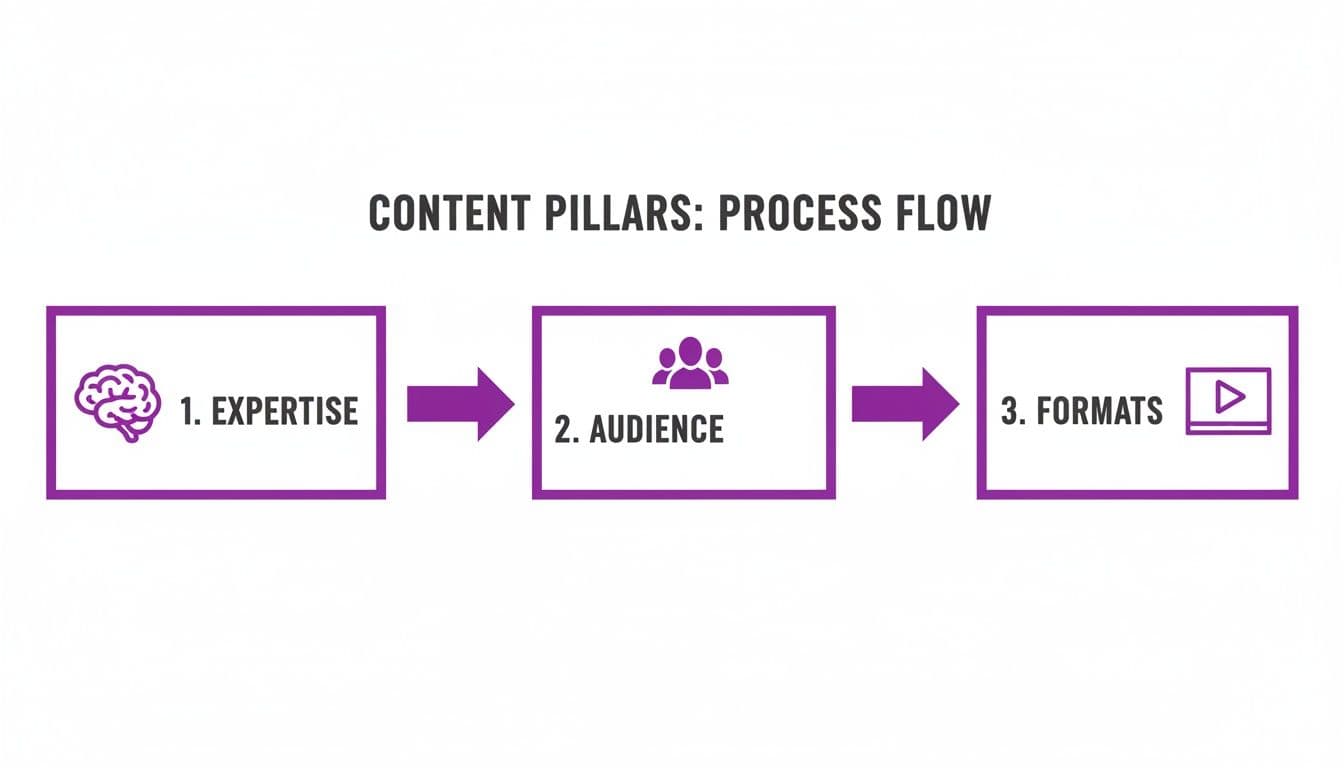
This process flow shows how your core strategy—your expertise, audience, and content formats—should be the foundation for all your planning.
Production and Post-Production: Getting It Done Efficiently
This is where the magic happens and your video takes shape. For musicians and karaoke channels, "production" is all about creating the visuals to go with your audio. The key here isn't to buy the most expensive, complicated software. It's about using the right tools for the job.
Modern, browser-based tools have been a complete game-changer. For instance, a platform like MyKaraoke Video uses AI to automate the ridiculously time-consuming task of syncing lyrics. What used to take me hours of painstaking, word-by-word manual timing can now be done in minutes.
This lets you take a finished song and turn it into a polished, 1080p karaoke video in a tiny fraction of the time. You can go from audio file to a YouTube-ready video without ever leaving your browser.
If you want to dive deeper into setting up a lean process, our guide on small business video production is a great next step.
Building a System That Scales
To keep up a consistent schedule, you have to work smarter, not harder. Two of the most powerful ways to do this are batch creation and building a library of reusable assets.
Batching is your best friend. It means you produce multiple videos in a single, focused session. Instead of going through the entire workflow for one video, you do each stage in bulk. Spend Monday scripting five videos. Tuesday, gather all the assets. Wednesday, produce all five. This assembly-line approach keeps you in the zone and dramatically boosts your output.
At the same time, start building a library of reusable assets.
- Branded Intros & Outros: Create a slick 5-10 second intro and outro with your logo. Slap them on every video to build instant brand recognition.
- Style Presets: Save your go-to font styles, color schemes, and background settings as templates. This keeps your look consistent without reinventing the wheel every time.
- End Screen Templates: Design a standard end card that pushes viewers to subscribe or watch another video. You can just drop it at the end of every new piece of content.
When you combine batching with a solid asset library, you create a powerful, efficient system. It's what makes creating content consistently not just possible, but sustainable for the long haul.
Mastering Video Distribution And Promotion
Let's be honest. Pouring your heart and soul into a video only to have it seen by a handful of people is crushing. A brilliant piece of content is useless if it never finds its audience.
This is where your distribution and promotion plan comes in. It’s the difference between a video that vanishes and one that thrives. Forget the old "publish and pray" tactic of just uploading to YouTube and hoping for the best. To get real traction, you need a proactive system to get your work in front of the right eyeballs.
Build Your Publishing Calendar
A good content calendar is the foundation of any solid distribution plan. Think of it less like a simple spreadsheet and more like your strategic command center. It maps out precisely when and where every video asset goes live to make the biggest splash.
A truly useful calendar should track:
- Publishing Dates and Times: Schedule posts based on when your audience is most active on each platform.
- Platform-Specific Assets: Note which format goes where (e.g., 16:9 for YouTube, 9:16 for Reels).
- Promotional Copy: Pre-write your captions, titles, descriptions, and hashtags for each network.
- Promotion Timeline: Plan out your teaser posts leading up to a major video launch.
This level of organization prevents the last-minute scramble and ensures you maintain a consistent, professional presence. It turns your content from a series of random acts into a coordinated campaign.
Optimize For Each Platform's Algorithm
Uploading the exact same video file everywhere is a classic rookie mistake. Every social network has its own algorithm, audience, and unwritten rules. To win, you have to play their game.
A full-length lyric video is perfect for YouTube, where longer watch times are rewarded. But that same video will fall completely flat on TikTok or Instagram Reels. You have to think natively for each environment you're posting in.
This is especially critical now, with over 75% of all video views happening on mobile and 70% of YouTube watch time coming from mobile devices. And since a whopping 85% of those mobile videos are watched with the sound off, features like the burned-in captions in your lyric videos are essential for grabbing attention. You can find more stats to guide your strategy in this in-depth report from Insivia.
The biggest mindset shift is to stop seeing other platforms as just places to dump your YouTube link. Treat each one—Instagram, TikTok, Facebook—as its own unique stage that requires a custom-tailored performance. That’s how you win.
Amplify Your Reach With Smart Promotion
Once your video is live and optimized, it's time to get loud. Don't just sit back and wait for the algorithm to do all the heavy lifting.
A few promotion tactics that actually work:
- Create Teaser Clips: Before a big launch, drop short, punchy clips (15-30 seconds) on Instagram Stories, Reels, and TikTok to build some real anticipation.
- Engage With Your Community: Never post and ghost. Respond to every single comment. This signals to the algorithm that your content is sparking conversation, which can give you a nice visibility boost.
- Collaborate With Other Creators: Partnering with other musicians or channels in your niche for a cross-promotional shoutout is one of the fastest ways to get in front of a new, relevant audience.
The Power Of Content Repurposing
For solo creators and small teams, this is the ultimate game-changer. Content repurposing is the art of taking one primary piece of content and slicing it into a bunch of smaller assets for different platforms. It’s how you multiply your output without multiplying your workload.
That one long-form lyric video? It’s a content goldmine.
Content Repurposing Matrix For Video
Here’s a quick look at how one core video asset can fuel your content calendar across multiple channels.
| Platform | Repurposed Format | Key Optimization Tip |
|---|---|---|
| Instagram Reels | A 60-second vertical clip featuring the most engaging part of your video. | Use trending audio as a background sound (in addition to your own) to tap into the discovery algorithm. |
| TikTok | A 15-30 second, fast-paced vertical video with on-screen text hooks. | Participate in a relevant trend or challenge using a snippet of your song or video. |
| YouTube Shorts | A vertical, sub-60-second highlight from your main video. | Create a "cliffhanger" short that points viewers to the full-length video for the complete experience. |
| Twitter / X | A compelling GIF or a short 15-second clip from the video. | Post the clip with an engaging question to spark conversation and retweets. |
| A 1-3 minute square video with burned-in captions. | Upload the video natively to Facebook (don't just share the YouTube link) for better reach in the newsfeed. |
By making repurposing a core part of your workflow, you can turn a single video production day into a week's worth of consistent content. This keeps you active on all the platforms that matter without burning out, making your video content marketing strategy both efficient and incredibly effective.
How to Measure and Optimize Your Strategy
Alright, you've done the hard work of creating and publishing your videos. That's a huge milestone, but the job isn't over. In fact, this is where the real magic happens. A great video strategy isn't something you set and forget; it's a living thing that you need to nurture with real-world data. Now, you get to put on your strategist hat and use analytics to fine-tune everything.
Let's be real, the internet is a noisy place. Getting noticed is tough, especially when video is expected to make up a massive 82% of all internet traffic. And with 95% of marketers saying video is a critical part of their strategy, you can't just throw content out there and hope for the best. You have to be smart about it.
Want more stats to back that up? Check out this great resource: these powerful video marketing statistics on TheDesireCompany.com.
Focus On Metrics That Actually Matter
First things first, let's get past the vanity metrics. Sure, a high view count feels great for the ego, but it doesn't really tell you if your content is hitting the mark or helping you reach your goals. We need to dig deeper into the Key Performance Indicators (KPIs) that show genuine connection and impact.
These are the numbers that will give you the real story:
- Watch Time: This is the total amount of time people have spent watching your videos. Platforms like YouTube absolutely love this metric because it's a strong signal of quality content that keeps people on their site.
- Audience Retention: This graph is a goldmine. It shows you, second by second, what percentage of your audience is still watching. You can pinpoint exactly where people get bored and click away.
- Click-Through Rate (CTR): This tells you how many people actually clicked on your video after seeing the thumbnail and title. A low CTR, even with a great video, often means your "packaging" isn't grabbing attention.
- Conversions: This is the bottom line. Are people doing what you want them to do? Are they subscribing, buying your merch, or joining your email list? This ties your video efforts directly to business results.
Shifting your focus from "views" to "watch time" is a game-changer. You stop chasing a click and start earning a viewer's most valuable asset: their time. This one mental switch will fundamentally improve the quality and impact of every video you make.
Using Analytics Tools for Actionable Insights
Your analytics dashboard, like YouTube Studio, is your best friend. Don't just give the numbers a quick glance—you have to learn to read the stories they're telling.
Pull up your audience retention graphs and look for patterns. Do you see a huge drop-off in the first 30 seconds of every video? That's a clear signal that your intros are too long or aren't getting to the point fast enough. On the flip side, do you see a section where people are constantly rewinding and re-watching? That's your "aha!" moment—a topic or style your audience loves. Double down on that.
To really understand how your videos are driving sales or sign-ups, you need to get familiar with the world of attribution in marketing. This helps you connect the dots between a specific video a person watched and the action they took later on your website.
Establish a Simple Performance Review Cycle
Data is only useful if you actually do something with it. I recommend setting up a simple monthly review to make this a habit.
- Pull the Core KPIs: At the end of each month, look at your watch time, audience retention, CTR, and conversions.
- Find Your Winners: Identify your top-performing videos for the month. What do they have in common? Was it the song choice? The thumbnail design? The video format?
- Analyze the Duds: Look at the videos that flopped. Be honest with yourself. Was the topic too niche? Was the title boring? Were the first 15 seconds a snoozefest?
- Set Actionable Goals: Based on what you learned, create one or two small, achievable goals for next month. It could be something like, "Test three new thumbnail styles to improve CTR," or "Cut all video intros to under 10 seconds."
This simple process turns analytics from a daunting task into your most powerful tool for growth. It ensures your strategy is constantly evolving and getting better with every single video you release.
Got Questions? Let's Get Them Answered
Diving into a video strategy always kicks up a few questions. Trust me, I've heard them all. Getting these sorted out early on can save you a ton of headaches and help you sidestep the common traps that stall so many creators.
Let's break down some of the most common hurdles I see musicians and small teams face.
How Often Should I Be Posting Videos?
Look, everyone wants a magic number, but the real answer is all about consistency, not just frequency. It’s a marathon, not a sprint.
It is far, far better for your channel's long-term health to post one fantastic, well-made video every week like clockwork than to dump three rushed, mediocre ones whenever you have a burst of energy. That path just leads to burnout for you and a confused audience.
Find a rhythm you can stick with. For most folks starting out, one or two solid videos a week is a perfect target. It's ambitious but totally manageable. Once you get your workflow dialed in and feel like a well-oiled machine, then you can think about ramping things up. Just never let your quality dip.
My two cents: Pop open your YouTube Analytics. It will literally show you the exact days and times your audience is online. If you schedule your uploads for those peak windows, you'll give your new video a much better shot at getting seen right out of the gate.
What Video Metrics Actually Matter?
It's so easy to get obsessed with the view count. But views are a vanity metric—they feel good, but they don't tell you if anyone actually liked what they saw. To really understand what's working, you have to look a little deeper.
These are the numbers I live by:
- Audience Retention: This graph is your best friend and your harshest critic. It shows you, second by second, where people are sticking around and where they're bailing. Find those drop-off points and figure out why they're happening.
- Watch Time: This is the big one. It’s the total number of minutes people have spent watching your stuff. YouTube's algorithm sees high watch time as a massive signal that you're creating quality content that keeps people on their platform.
- Click-Through Rate (CTR): This tells you how many people saw your thumbnail and title on their screen and were compelled enough to actually click on it. A low CTR is a sign that your packaging—your thumbnail and title—needs a serious rethink, even if the video itself is a masterpiece.
Tracking these KPIs gives you the real story. It’s the difference between knowing your video was seen versus knowing it made an impact.
How Do I Make Great Videos Without Breaking The Bank?
You absolutely do not need a Hollywood budget to create videos that look and sound professional. The trick is to be smart about where you spend your money and, more importantly, your time.
First things first: prioritize good audio. I can't stress this enough. People will forgive a slightly shaky camera, but they will click away in a heartbeat if the sound is fuzzy, echoey, or hard to understand. A solid USB microphone is probably the single best investment you can make, and it will instantly make your videos feel more professional. Your smartphone camera is likely more than good enough for the video side of things.
The real game-changer for anyone on a budget, though, is having an efficient workflow. Instead of spending a fortune on complex editing software (and the weeks it takes to learn it), find tools that simplify or automate the tedious parts. This approach lets you produce polished videos without draining your bank account or your energy, so you can focus on the stuff that really grows your channel—like actually promoting your work.
Ready to create stunning lyric and karaoke videos without the headache of complicated software? MyKaraoke Video uses AI to automate lyric syncing, letting you produce professional 1080p videos in minutes, right from your browser. Start creating for free today at https://www.mykaraoke.video.