You're staring at three pricing cards for a karaoke video tool. The free plan looks restrictive, the $9 Starter plan seems reasonable, and the $29 Pro plan includes the export features you need. You're not comparing prices alone. You're trying to identify which version of the product matches your workload without paying for capabilities you won't use.
That decision is the purpose of a tiered pricing model. Done well, it lets creators, small businesses, and SaaS buyers self-select into a plan that reflects their needs. Done badly, it produces confusing cards, arbitrary limits, reluctant upgrades, and expensive billing support.
What a Tiered Pricing Model Actually Is
A tiered pricing model sells one product through several discrete plans. Each plan has its own price, feature bundle, service level, or usage allowance. Buyers choose a package rather than assembling every capability à la carte or receiving a bill based entirely on consumption.
The structure usually has three visible traits:
- Plans appear upfront: Buyers can compare options before speaking with sales or starting a workflow.
- Each tier has fences: Features, seats, storage, exports, support, or processing capacity differ between plans.
- Upgrades happen in steps: A customer moves from one package to another instead of making a continuous adjustment to every individual feature.
A creator might begin with a free plan for occasional lyric videos, move to a Creator plan for more exports, and choose a Studio plan when collaboration, higher processing capacity, or advanced controls become necessary. The product stays the same, but the commercial package changes with the customer's situation.
The middle path between flat and metered pricing
Flat-rate pricing gives everyone the same package at the same price. It's simple, but it can overcharge light users and undercharge heavy users. Pure usage-based pricing moves in the opposite direction. Customers pay according to renders, API calls, minutes, storage, or another meter, which can feel fair but may make costs harder to predict.
Tiering sits between those models. It creates structured choice without requiring custom negotiation. The vendor can serve beginners, regular users, and demanding teams with a small set of predefined offers. The buyer gets a clearer decision than a usage calculator would provide, while the company captures more willingness to pay than a single flat plan allows.
Historically, tiered pricing evolved from versioned services in utilities, telecom, and other industries before becoming widespread in telecom during the 1990s and 2000s and SaaS packaging during the 2000s and 2010s, as described in this history of tiered pricing frameworks. That history matters because tiering isn't merely a SaaS page layout. It's a form of nonlinear pricing that connects price to features, quantity, service level, or usage.
Practical rule: A tier should represent a meaningful change in the customer's job, not an arbitrary collection of extra checkmarks.
The biggest mistake is treating tiers as three price points with random features scattered between them. A useful ladder gives each plan a role. The entry tier removes risk, the middle tier solves the core problem for the broadest audience, and the top tier serves users whose volume, collaboration needs, or business consequences justify a premium.
How Tiered Pricing Works Step by Step
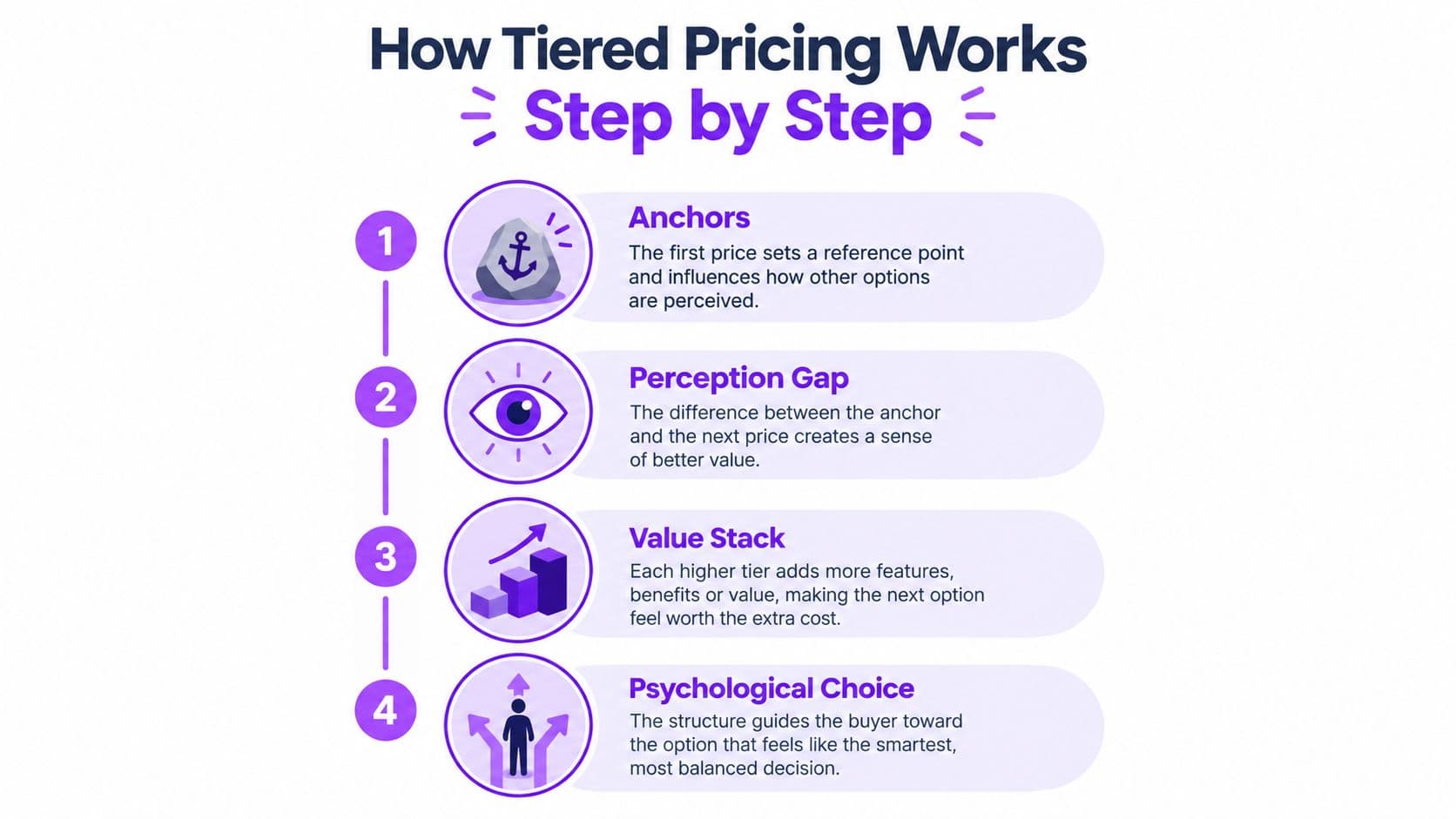
A pricing ladder succeeds when four decisions reinforce one another. Get the thresholds or fences wrong, and polished pricing cards still produce weak self-selection.
1. Start with anchors
An anchor gives buyers a reference point for judging every other price. The middle plan should usually carry the “recommended” label because it defines the product's normal value before the buyer considers the premium option.
Consider this ladder:
- Free: Basic creation with limited access.
- $12 Creator: More capacity and essential exports.
- $29 Pro: Higher limits, stronger controls, and broader output options.
- $79 Studio: Collaboration, advanced administration, and the greatest capacity.
The $79 plan makes $29 feel accessible to a serious individual creator. Free makes $12 feel like a manageable move into paid use. The anchor is not necessarily the plan with the highest conversion. It is the reference that makes the full ladder easy to judge.
2. Design the gaps
Adjacent paid tiers need a visible value step. For SMB SaaS, a practical starting range is 1.8x to 2.5x between plans, while creator tools often need tighter spacing because individual buyers react strongly to price jumps. Treat that range as a design framework, not a rule. A wider gap needs a clear upgrade reason, such as team access, higher output, or a business-critical control.
Benchmark guidance also recommends gaps of roughly 2.1x to 2.8x between adjacent tiers, giving customers a meaningful expansion path while preserving the middle plan's appeal. That recommendation reflects common SaaS packaging guidance summarized in this guide to SaaS pricing benchmarks. For mixed creator and SMB audiences, test whether the gap causes users to skip the middle plan or remain stuck on entry pricing.
3. Build feature fences
A feature fence reserves a capability for a specific plan. Strong fences separate customer jobs, including team permissions, advanced analytics, API access, priority support, or professional export formats. Weak fences block actions every user expects, making the entry plan feel deliberately broken.
Assign each tier one primary upgrade reason. Secondary improvements can support it, but they should not compete with it.
4. Add usage limits carefully
Usage limits create upgrade pressure as customers receive more value. Renders, storage, notifications, API calls, and export minutes can work as soft caps when buyers understand the limit before crossing it and can see exactly what the next plan changes.
Do not stack too many fences into one ladder. If Creator limits exports, removes collaboration, and restricts formats while Pro changes all three, the upgrade message becomes muddy. Choose one dominant threshold, then use the other limits to reinforce the same customer outcome.
Real Advantages and Hidden Drawbacks of Tiers
Tiering earns its popularity because it solves several revenue problems at once. A customer can understand three cards faster than a metered pricing calculator, and a company can forecast subscription revenue more easily when buyers commit to monthly plans. The model also gives self-serve customers a clear path from initial adoption to expansion.
A well-positioned ladder does four useful things:
- Improves comparison: Buyers can evaluate packaged outcomes rather than audit every optional feature.
- Creates predictable commitments: Monthly or annual plans provide a clearer commercial relationship than entirely variable billing.
- Supports self-serve conversion: Customers can choose without waiting for a salesperson to configure a quote.
- Makes expansion visible: The next plan gives customers a defined destination when their workflow grows.
Benchmark summaries published for 2026 report that about 67% of SaaS products use tiered plans, while a 619-company OpenView benchmark cited in those summaries reported tiered or packaged pricing adoption at 41% in 2023 and 39% in 2025. The same summaries report usage-based pricing moving from 27% to 34% over that period, which indicates that tiers remain common even as hybrid models gain ground. See the 2026 startup pricing strategy benchmark summary for the cited figures.
The failure modes operators discover later
The first problem is self-selection failure. If the entry and middle plans solve almost the same job, customers stay cheap. If the middle plan is dramatically more expensive without a visible change in outcome, users remain free or leave. Your pricing page then creates choice without creating movement.
The second problem is operational. Every tier adds entitlement rules, support questions, billing exceptions, upgrade paths, downgrade behavior, and testing requirements. A team that launches a fourth tier to accommodate one new feature may create more complexity than revenue.
The third is cannibalization. Heavy users may remain on a low-priced tier if you raise its limits without adding a compelling fence. The opposite problem is stagnation. A fixed package can become crowded as new capabilities arrive, forcing you to cram features into existing plans or add another card.
| Dimension | What Tiers Give You | What Tiers Cost You |
|---|---|---|
| Buyer choice | Clear packages for different needs | More decisions when differentiation is weak |
| Revenue | Predictable plans and upgrade paths | Cannibalization if limits don't create movement |
| Operations | Repeatable entitlement rules | More billing and support edge cases |
| Product packaging | A visible value ladder | Pressure to keep outdated bundles coherent |
| Customer experience | Self-serve selection | Confusion around thresholds and downgrades |
Tiered pricing isn't automatically simple. It's simple only when the customer can explain why each plan exists in one sentence.
Tiered Pricing Examples From SaaS and Creator Platforms
The most useful way to study tiered pricing is to examine the fence, not just the price card. A SaaS company may use seats and permissions, while a creator platform may use audience access, exports, storage, or processing capacity. The commercial logic changes with the product's value metric.
| Platform | Tier Count | Anchor Tier | Gap Ratio to Next | Primary Fence |
|---|---|---|---|---|
| HubSpot | Multiple product and service tiers | The plan matching the team's operating stage | Varies by product and configuration | Seats, feature depth, automation, and service level |
| Notion | Multiple workspace plans | The team plan for collaborative use | Varies by billing configuration | Members, permissions, administration, and collaboration |
| Patreon | Membership and creator options | The creator's practical operating level | Varies by creator setup | Fan access, creator tools, and platform economics |
| Canva Pro | Free and paid options | The individual paid plan | Varies by selected plan | Premium assets, brand controls, and creation capacity |
| MyKaraoke Video | Free, credits, and subscription options | The recurring plan matching regular creation | Varies by credit allocation | Monthly credits and processing privileges |
The table exposes a key distinction. HubSpot and Notion primarily signal organizational maturity. Higher tiers suggest more users, governance, automation, and control. Patreon's structure is connected to the creator's relationship with an audience, so access and monetization mechanics matter more than a simple feature checklist.
Canva's logic is closer to a creator workflow. The paid anchor needs to justify itself through assets, brand consistency, and production convenience rather than only through a larger user count. A smaller product serving karaoke channel managers, musicians, and social creators may need to combine a free entry point with credits and recurring plans because usage can vary sharply from one month to the next.
What the gap tells the buyer
The price gap should communicate a change in operating mode. Moving from an individual creator plan to a team plan should enable collaboration or control. Moving from a light-use video plan to a power-user plan should increase production capacity or reduce friction. If the only difference is a larger number beside an otherwise identical checklist, the customer sees an upsell tax.
For teams exploring AI-assisted video workflows, a useful next step is to get started with AI video and identify which parts of the workflow create recurring value. That exercise helps distinguish a genuine feature fence from a decorative plan difference.
The strongest tier examples don't ask, “What can we put in the expensive plan?” They ask, “Which customer behavior proves that the expensive plan is now necessary?” That answer should determine the fence, the threshold, and the upgrade message.
Designing Tiers That Convert Without Overload
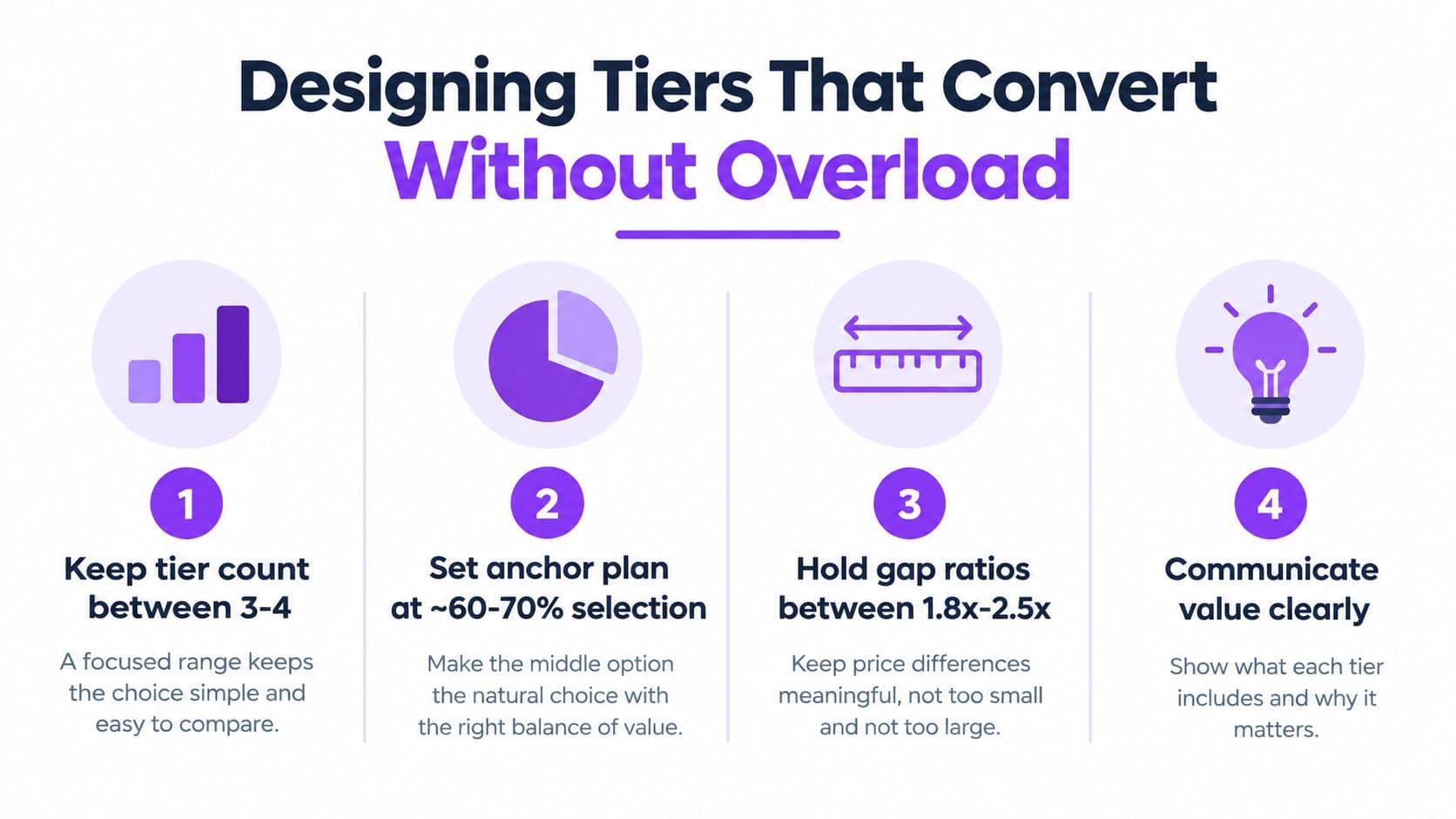
Keep the ladder narrow. A 2026 benchmark of 218 pricing pages found median visit-to-trial or signup conversion of 4.7% for three-tier pages, compared with 3.8% for four-tier pages and 3.3% for pages with five or more tiers. The dataset also reported three-tier pages converting 41% better than four-tier pages and 20% better than two-tier pages. The pricing page conversion benchmark supports a clear recommendation: start with three tiers, add a fourth only when the customer segment or economics requires it.
Use a disciplined ladder
For a creator or SMB product, begin with three or four tiers. Give each one a job:
- Entry: Removes adoption friction and proves the core outcome.
- Anchor: Solves the main recurring use case for most paying customers.
- Premium: Handles advanced workflows, collaboration, or material capacity.
- Specialist, if necessary: Serves a distinct operational segment, not merely a slightly larger number.
Place the anchor plan where roughly 60% to 70% of new customers would plausibly choose it. Treat that as a target for testing, not a promise. If selection falls below 50%, investigate whether the plan is poorly named, underpowered, overpriced, or squeezed between two more attractive options.
Hold adjacent paid-plan gaps around 1.8x to 2.5x for the initial design. Reserve the top tier for roughly 5% to 10% of users, provided that those users generate enough value or absorb enough cost to justify the offer. These thresholds come from the requested operating framework, while the broader benchmark evidence also supports keeping the ladder constrained.
Fence value before you cap activity
Use collaboration, analytics, permissions, brand controls, export formats, or workflow automation as feature fences. These capabilities often separate casual creators from professional teams more cleanly than an aggressive hard cap on basic activity.
Usage limits still matter, but they should be legible and proportionate. Show what happens when a customer reaches a limit, whether access pauses, an overage applies, or an upgrade becomes available. You can also use add-ons for exceptional needs, but don't turn the pricing page into a menu of small charges.
Before launch, audit the ladder against this checklist:
- Names: Does each plan name describe the customer's stage or job?
- Price points: Can a buyer explain the jump between plans?
- Feature isolation: Is the primary upgrade reason exclusive to one tier?
- Thresholds: Do limits reflect actual usage clusters rather than round numbers chosen for convenience?
- Downgrades: Can customers understand what disappears and when?
- Add-ons: Do they handle edge cases without weakening the core upgrade path?
For teams improving audience response around a creator product, this guide to increasing customer engagement can complement the pricing work. Engagement matters because a tier only converts when users reach the behavior that makes its additional value obvious.
Metrics That Tell You Your Tier Ladder Is Working
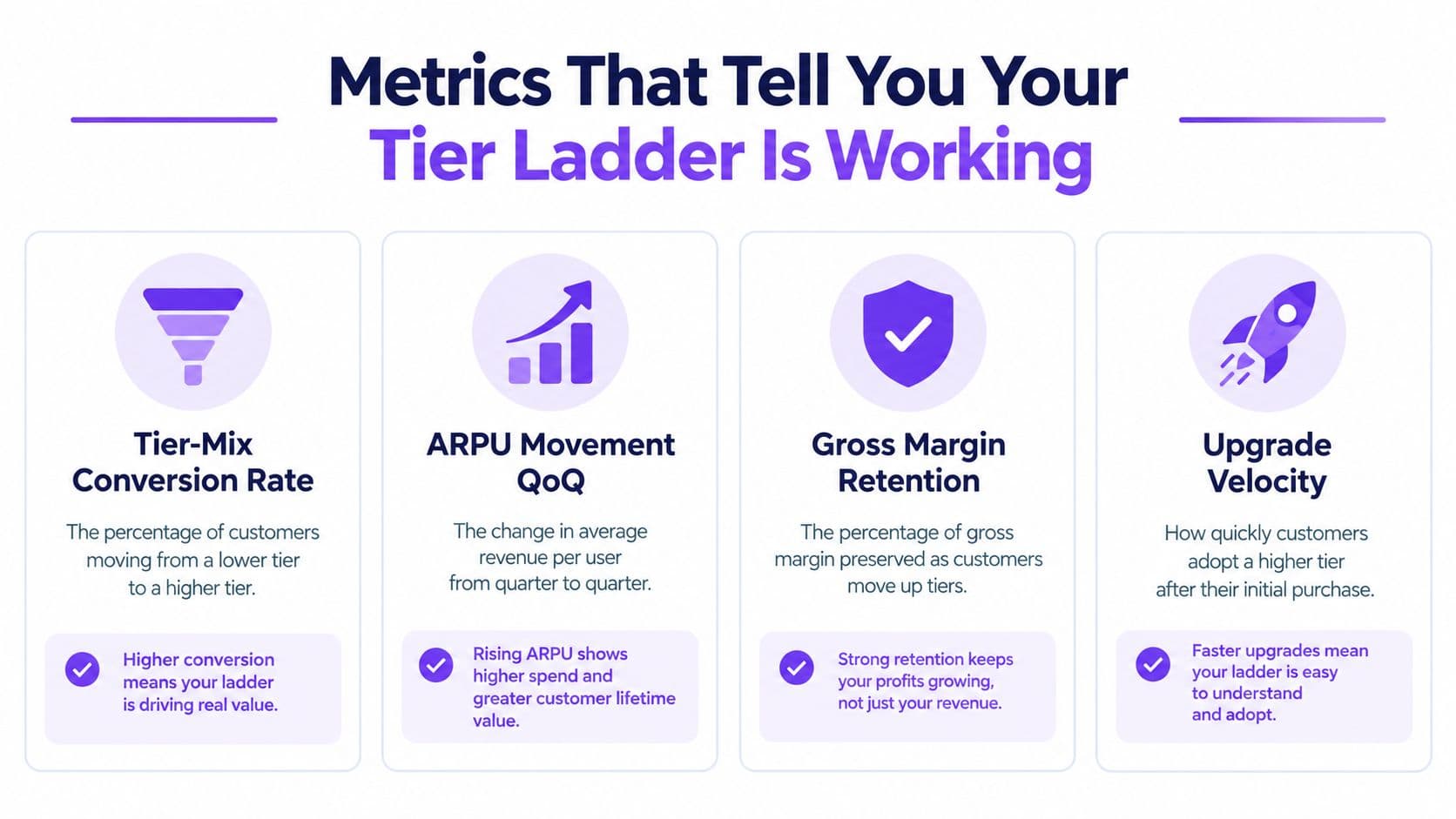
A clean pricing page can still produce weak revenue. Judge the ladder by how customers select, expand, retain, and leave each plan, not by signups alone.
Tier-mix conversion rate
Measure conversion by selected plan, acquisition source, customer type, and first meaningful usage event. Total conversion can hide a poor ladder if new customers cluster in the free or lowest paid plan and rarely expand. Track the anchor plan separately. If anchor selection falls below 50%, treat it as a design warning. Recheck its value, price, positioning, and the gap between it and adjacent tiers.
ARPU movement
Track average revenue per user quarter over quarter, segmented by acquisition cohort and original plan. ARPU rising through genuine upgrades indicates stronger packaging. ARPU rising because of price increases, followed by downgrades, does not.
A SaaS benchmark reports average ARPU of $127 per month in a 500-plus-company panel, but that figure is context, not a target for a creator product with different customers and cost structure. The SaaS pricing benchmarks guide also reports 32.7% expansion revenue and 5.2% churn alongside its tiered-model data. Use those figures to frame questions, not to copy a target blindly.
Expansion and retention quality
Expansion is healthy when customers pay more because they receive more value. Track gross margin retention by plan as well as expansion revenue. An upgrade that raises processing costs faster than revenue is a pricing failure, even if top-line revenue increases.
Voluntary downgrades
Downgrades expose misaligned fences. Segment them by reason, prior usage, feature adoption, billing cycle, and the capability customers lose. A downgrade after a premium feature goes unused points to a packaging problem. A downgrade after an unexpected limit points to a trust problem. Pair these findings with threshold proximity, because a gap that is too wide can leave mixed-usage creator and SMB customers with no credible next step.
Flag expansion revenue when it stalls for two consecutive quarters. Inspect the path from feature adoption to approaching a limit to seeing an upgrade prompt. For MyKaraoke Video and similar products, the overview of social media engagement metrics helps separate activity inside the product from downstream audience performance.
When to Combine Tiers With Usage and How to Roll Out
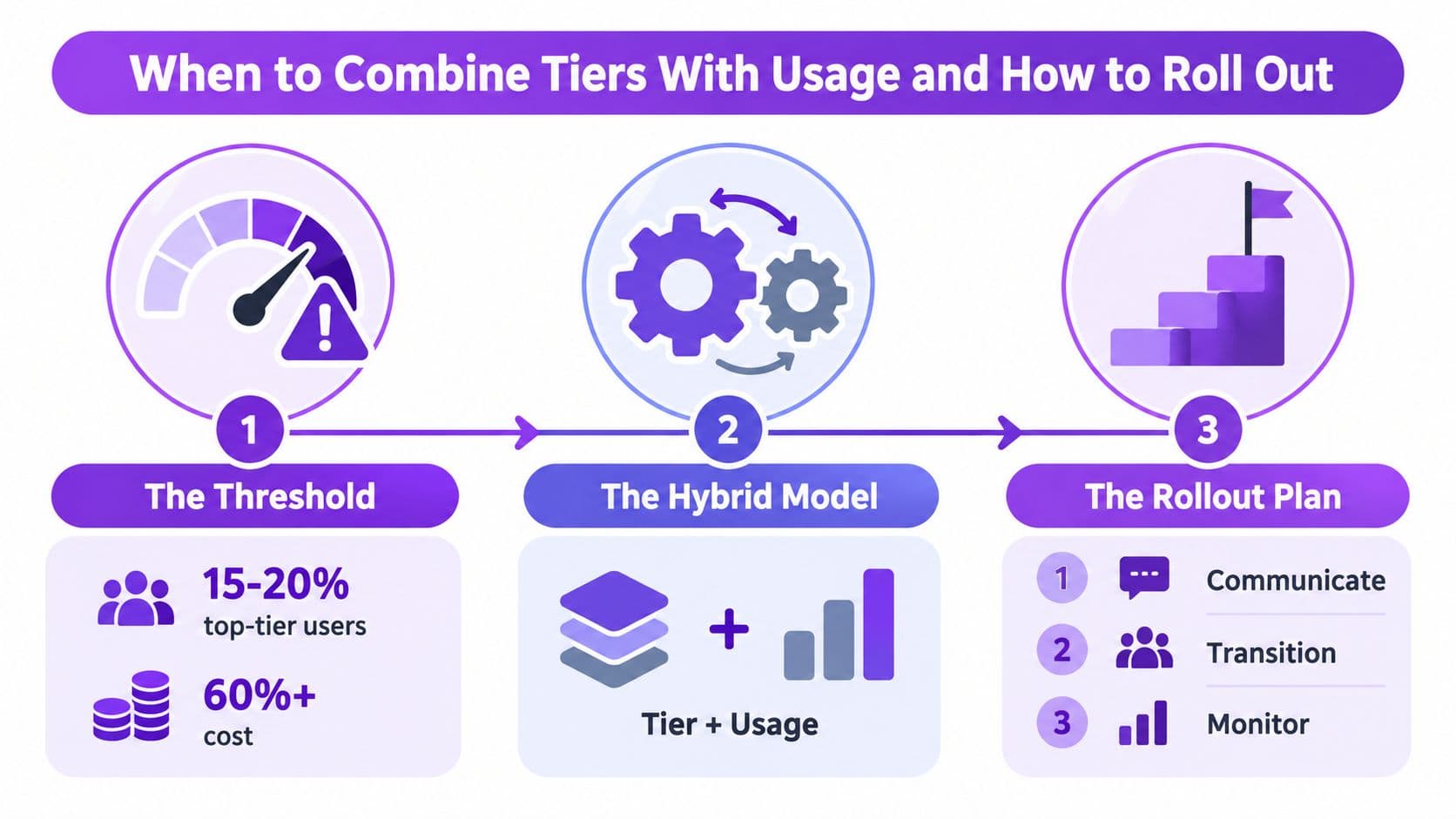
Pure tiers stop working when customer consumption becomes too uneven for a fixed allowance to protect your margins. A practical warning line is reached when 15% to 20% of top-tier users consume 60% or more of infrastructure cost. At that point, charging every top-tier customer the same amount subsidizes heavy users with light users' payments.
Hybrid pricing is the better answer above that line. It preserves predictable packages for most customers while making exceptional consumption visible.
Choose the hybrid structure deliberately
- Soft cap with overage: Include a generous allowance, then charge for usage beyond it.
- Seat plus usage band: Combine a predictable per-seat charge with a capacity range.
- Credit pool: Give each tier a credit allocation and let power users purchase additional credits without changing their base plan.
The third approach often fits creator products well because credits can represent renders, export minutes, or other expensive processing events. Keep the rules visible. Customers should see remaining capacity, projected charges, and the action that prevents an unwanted bill.
Roll out in controlled phases
For a product such as MyKaraoke Video, use four 60 to 90 day testing cycles:
- Launch three tiers: Keep the free plan generous enough to demonstrate the core result, then offer a clear recurring anchor and a premium plan.
- Instrument behavior: Record feature adoption, usage thresholds, upgrades, downgrades, support contacts, and cost per active account.
- Test top-tier overage: Introduce usage limits and overage only in the premium tier first, where customers have already demonstrated stronger value.
- Test creator credits: Evaluate a credit or export-minute bundle for power creators who need flexibility without a permanent subscription jump.
Don't advance a phase if customers can't predict what they'll pay, support volume rises sharply, or downgrade complaints cluster around a newly introduced limit. Roll back the change, repair the communication, and restart the cycle with cleaner instrumentation.
Hybrid pricing is increasingly relevant because current market commentary reports that 51% of recurring-revenue companies combine subscriptions with usage-based pricing, while other analysis finds hybrid structures common among AI companies. The Salesforce guide to tiered pricing frames the underlying design issue clearly: customers differ in needs and willingness to pay, so the package must reflect that difference without making selection painful.
For small teams building repeatable acquisition and retention systems, this guide to marketing automation for small business can help connect pricing events with lifecycle communication. A customer should receive a clear warning, useful guidance, and a relevant upgrade prompt before a threshold becomes a billing surprise.
MyKaraoke Video lets creators turn songs into karaoke or lyric videos in the browser, with automatic lyric syncing, a sync editor, customization controls, and output options such as 1080p MP4. Review its free, credit-based, and subscription options, then use the tier logic above to choose the plan that matches your publishing volume by visiting MyKaraoke Video.