A true Japanese karaoke bar is a world away from the Western concept of singing in front of a room full of strangers. Think less of a public performance and more of a private party. It’s a soundproof room you rent by the hour for just you and your friends—a social ritual built around fun, food, and music in your own exclusive space.
What to Expect Inside a Japanese Karaoke Bar
If you’re imagining a nerve-wracking open mic night, you can relax. The classic Japanese experience, known as a "karaoke box," is all about privacy and comfort. When you walk into one of these places, you’re greeted by a lobby that leads to a hallway of private rooms. Each one is a self-contained sanctuary for you and your group to let loose.
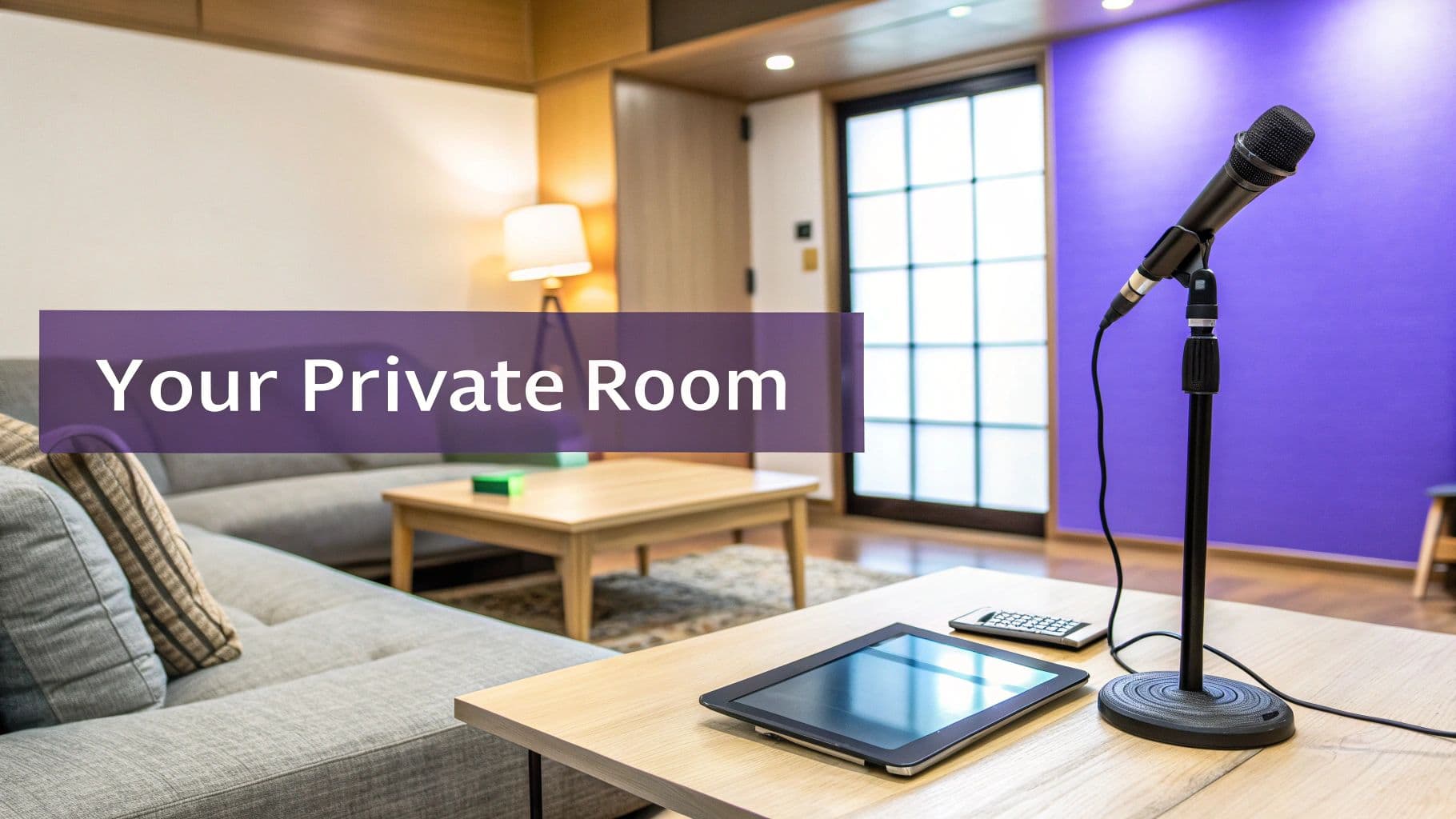
It’s almost like booking a private movie screening, but instead of just watching the show, you and your friends are the show. These rooms become your personal concert venue for as long as you’ve booked them.
The Atmosphere and Amenities
Once you’re led to your room, you'll find it’s kitted out with everything you need for a fantastic session. The whole vibe is designed to make you feel comfortable, encouraging even the shyest person in your group to grab a microphone.
Here’s a quick rundown of what you’ll almost always find inside:
- Comfortable Seating: You'll see plush sofas and chairs arranged around a large screen, giving it a cozy, lounge-like feel.
- High-Tech Equipment: A big TV or projector screen displays the lyrics, powered by a surprisingly good sound system. And yes, there are always multiple microphones.
- The Control Hub: Your command center is usually a tablet or a chunky remote control. This is where you’ll browse the massive song library, queue up your next hit, and adjust the volume or even the key.
- In-Room Service: A dedicated phone or tablet lets you order food and drinks directly to your room, so the party never has to stop. The menus are often huge, with everything from fries and pizza to classic Japanese snacks and a full bar selection.
The whole point of a Japanese karaoke box is to create a private, judgment-free zone where you and your friends can just have fun. It’s not a competition; it’s a shared experience centered on pure, collective enjoyment.
A Ritual of Connection
Beyond the tech and neon-lit hallways, karaoke is a huge part of social life in Japan. It’s the go-to activity for coworkers unwinding after a long day, a classic weekend plan for friends, and even a popular choice for family outings.
This private setup creates a unique sense of camaraderie, making it easy for everyone to join in without feeling pressured. It’s this focus on creating a personal, shared moment that makes a trip to a Japanese karaoke bar so unforgettable—and a true staple of modern culture.
The Surprising Story of How Karaoke Began
To really get what a Japanese karaoke bar is all about, you have to know its story. This isn't some slick corporate invention. Karaoke came from a very human place: a musician wanting to help regular people have a little more fun when they sang.
It all started back in the early 1970s with a guy named Daisuke Inoue. He was a keyboardist playing in bars around Kobe, Japan, and his customers kept asking him for tapes of his backing tracks. They wanted to be able to sing along on their own, maybe to practice for a company party or just for fun on a business trip. That simple request sparked a huge idea.
So, Inoue built a machine. It was a pretty basic box that played instrumental versions of popular songs on 8-track tapes. For 100 yen, anyone could be the lead singer. He called it the "Juke-8." He never patented it—missing out on a fortune, sure—but he gave the world an incredible gift. He also gave it its name: "Karaoke," a mash-up of the Japanese words "kara" (empty) and "ōkesutora" (orchestra). An empty orchestra.
From Open Mics to Private Rooms
At first, these new karaoke machines were mostly found in snack bars (スナック). These are small, intimate bars where you'd sing in front of everyone else. It was fun, but let's be honest, singing in front of strangers can be terrifying. This fear gave rise to the next big leap forward in the 1980s: the karaoke box.
The karaoke box was a total game-changer. Instead of one big room, companies started building venues with dozens of small, private, soundproof rooms that groups could rent by the hour. Suddenly, karaoke wasn't a public performance; it was a private party. You could be as silly or as off-key as you wanted with your friends. This is the model that made the Japanese karaoke bar a cultural juggernaut. It created a judgment-free zone for people to just let loose.
The real magic happened when karaoke moved from a public stage to a private room. It stopped being about individual performance and became a way for groups—friends, families, coworkers—to bond and have fun together.
Of course, the technology raced to keep up. The clunky 8-tracks gave way to laserdiscs, which brought music videos and cheesy background visuals into the mix. Before long, fully digital systems took over, giving singers searchable libraries with tens of thousands of songs right at their fingertips.
A Social Ritual That Keeps Evolving
Today, karaoke is woven into the very fabric of Japanese social life. It's the default activity for after-work parties, birthday celebrations, and weekend hangouts. A big reason it has lasted so long is its ability to adapt. The industry is always adopting new tech, from tablet-based song selection to professional-grade sound mixing controls in every room.
That resilience was really put to the test recently, but the cultural pull of karaoke won out. After a major dip during the global pandemic, the Japanese karaoke market made an incredible comeback. The market, which was around ¥576.5 billion in 2019, bounced back to a staggering ¥443 billion by 2023. It’s clear people were desperate to get back to this essential social ritual.
From Inoue’s humble Juke-8 to the high-tech karaoke palaces of today, the core appeal is exactly the same: a place for pure, unadulterated fun and connection. If you want to dig a little deeper, we have a whole piece on where did karaoke originate.
Choosing Your Venue: Karaoke Boxes vs. Snack Bars
So, you've decided to dive into the world of Japanese karaoke. Awesome. But your first big decision is where to go, because not all karaoke spots are created equal. In Japan, you've basically got two main choices: the modern karaoke box or the old-school snack bar.
Think of it like this: a karaoke box is your own private, soundproofed party room that you rent by the hour. It’s just you, your friends, a giant screen, and a high-tech sound system. This is what most people imagine when they think of karaoke in Japan today.
A snack bar, or sunakku (スナック), is the total opposite. It's a small, cozy neighborhood bar, usually run by a charismatic owner known as a "mama-san." Here, singing is a public event. You perform for everyone in the bar, who are mostly local regulars.
Getting this choice right is the key to having a great night, so let's dig into what makes each one unique.
The Modern Karaoke Box: Your Private Stage
The karaoke box is all about privacy and control. Big chains like Big Echo, Karaokekan, and Joysound are everywhere, offering a slick, easy-to-use experience that’s perfect for anyone new to the scene. You book a room for a specific time slot, order food and drinks from a tablet, and are free to sing your heart out without worrying about who's listening.
This is the perfect setup for:
- Groups of friends who want to let loose and be goofy without an audience.
- Families looking for a fun activity that works for all ages.
- First-timers who are a bit nervous about singing in front of strangers.
These places are a huge part of the entertainment industry in Japan. Karaoke boxes completely dominate the market, pulling in a staggering ¥297.3 billion in revenue. For comparison, bars and other establishments with karaoke setups brought in ¥112.3 billion, which just goes to show how popular the private room model has become.
The Traditional Snack Bar: The Community Stage
Stepping into a snack bar feels less like a business and more like you've been welcomed into a local hangout. The vibe is warm, intimate, and all about community. The "stage" is just a spot at the front of the bar, and instead of a flashy tablet, you might be handed a thick, well-worn songbook.
A snack bar isn't just about singing—it's about connecting. You're not really a customer; you're more like a temporary regular, sharing songs and stories with the locals and the mama-san.
This experience is ideal for:
- Solo travelers looking for a genuine local interaction.
- Confident singers who get a kick out of performing for a small, friendly crowd.
- Japanese speakers who want to practice their skills in a real-world setting.
Karaoke Box vs Snack Bar: What to Expect
To make the decision even easier, here's a quick side-by-side look at what you can expect from each type of venue. This should help you figure out which kind of night you're really looking for.
| Feature | Karaoke Box (e.g., Big Echo, Karaokekan) | Snack Bar (スナック) |
|---|---|---|
| Atmosphere | Private, modern, high-energy | Public, intimate, cozy, local |
| Audience | Just your own group | Other patrons (usually regulars) & staff |
| Song Selection | Massive digital library (often 100,000+ songs) | Smaller, curated selection, often older hits |
| Booking | Rented by the hour/30-min block | Usually a cover charge ("seat charge") plus drinks |
| Food & Drink | Extensive menu ordered via phone/tablet | Limited snacks and standard bar drinks |
| Best For | Groups, parties, shy singers, families | Solo travelers, cultural immersion, confident singers |
Ultimately, choosing between these two amazing styles of Japanese karaoke bar comes down to what you want from your night. If a private party with your crew sounds like a blast, a karaoke box is your best bet. But if you’re craving a one-of-a-kind cultural adventure and don't mind a small audience, a snack bar will give you a story to tell for years.
Karaoke technology itself has come a long way, evolving from humble beginnings to today's sophisticated systems.
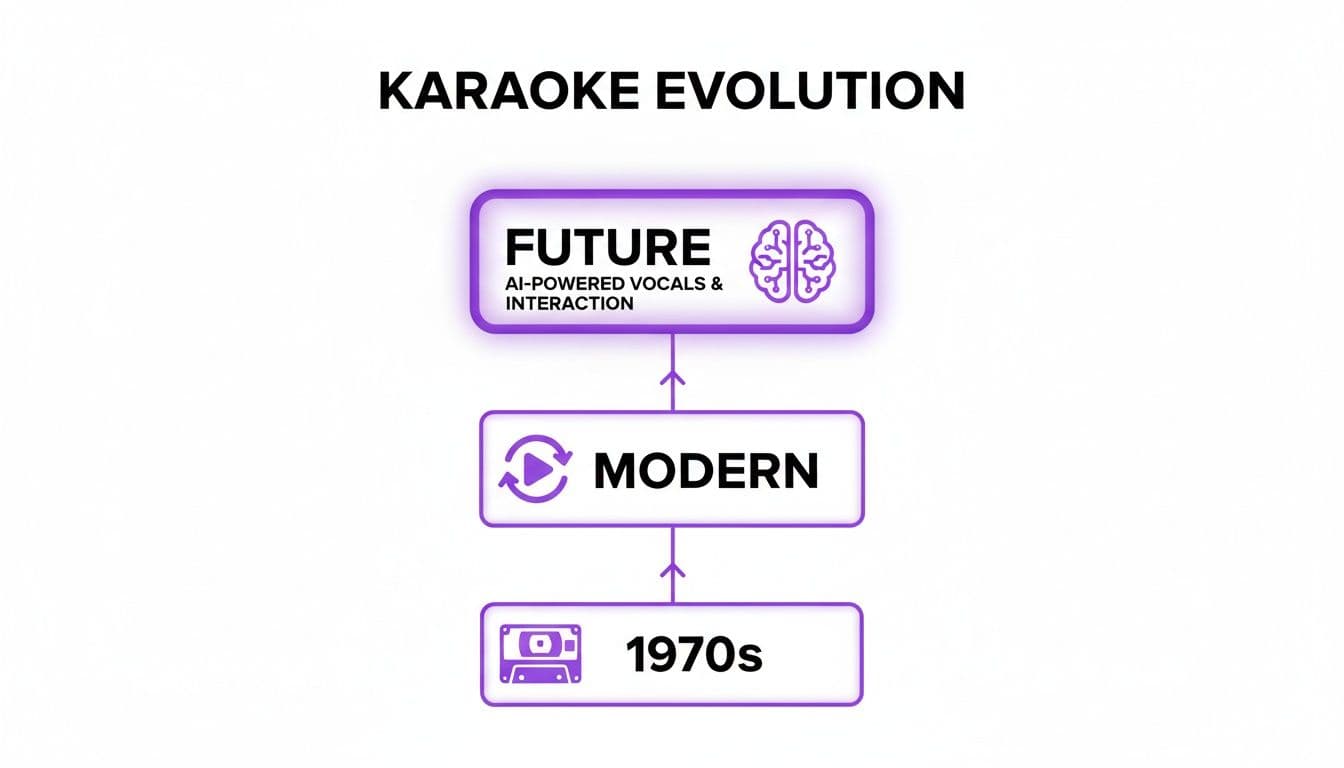
As you can see, the journey started with 8-track tapes in the 1970s and has moved all the way to cloud-based streaming. The next frontier even points toward AI-driven features, showing just how much this beloved pastime continues to adapt and grow.
Your Step-By-Step Guide to a Flawless Karaoke Night
Alright, you’ve picked a spot and are buzzing with excitement. Let’s walk through exactly what to do from the moment you step through the door to your final, epic high note. Navigating a Japanese karaoke bar is surprisingly simple once you know the rhythm, and I'll break it down so you feel like a regular on your very first visit.
Think of it like checking into a hotel, but instead of a bed, you get a stage. Walk up to the front desk and tell the staff just two things: how many people are in your group and how long you want to sing.
Even if your Japanese is rusty, don't sweat it. Holding up fingers for the number of people and the hours you want is a universal language they’ll understand perfectly.
Choosing Your Time and Plan
At the counter, you'll be shown a menu of pricing plans. Getting your head around these is the key to a great night that doesn't break the bank. Just remember, nearly all karaoke boxes charge per person, not a flat fee for the room.
Here are the usual suspects when it comes to pricing:
- 30-Minute Blocks: This is the basic, pay-as-you-go option. You’re charged for every half-hour you’re in the room. It’s flexible for a quick session, but the cost can creep up if you lose track of time.
- "Free Time" (フリータイム): This is your best friend for a marathon singing session. You pay one flat rate for a huge chunk of time—often 3-5 hours, sometimes even all night long. For anything over an hour and a half, this is almost always the cheapest way to go.
- Drink Plans: Most places have a mandatory "one-drink system," meaning each person has to buy at least one beverage. A popular upgrade is the all-you-can-drink plan, or "nomihodai" (飲み放題). If your crew is thirsty, this can be a fantastic deal.
Pro Tip: Want the full experience for half the price? Go during the day on a weekday. The daytime rates are a steal compared to the prime-time evening and weekend prices.
Once you’ve picked your plan, the staff will give you a slip of paper with your room number and, crucially, your end time. Then they’ll point you down a hallway to your private musical paradise.
Getting Settled in Your Room
Finding your room is a piece of cake—just match the number on your receipt to the number on the door. Inside, you'll find your command center: a couple of microphones, a big TV screen, and the most important piece of equipment, the song-selection tablet.
Get yourselves comfortable, and then find the in-room telephone. This is your lifeline to the outside world, or more specifically, the kitchen. There’s no need to ever leave the room.
You can browse the entire food and drink menu on the tablet or a physical menu, then simply pick up the phone and place your order. Minutes later, someone will knock and deliver it right to your door. This seamless service is part of what makes Japanese karaoke so amazing—it’s all about uninterrupted fun.
Managing Your Time and Extending Your Stay
About 10-15 minutes before your time is up, the phone in your room will ring. It's a friendly courtesy call from the front desk letting you know your session is coming to a close. This is your cue to queue up that one last show-stopper.
But what if you're just getting warmed up? No problem. When they call, you can almost always ask to extend your time, usually in 30-minute blocks. As long as the room isn't booked right after you, they’re happy to let the party continue.
When your time is finally up, grab your jackets and head back to the front desk. Hand over the receipt or room card they gave you earlier. They’ll tally up your total—the room charge plus any food and drinks—and you can settle the bill. Just like that, you’re done! You can head out into the night with ringing ears and a story to tell.
How to Master the Remote and Find Your Songs
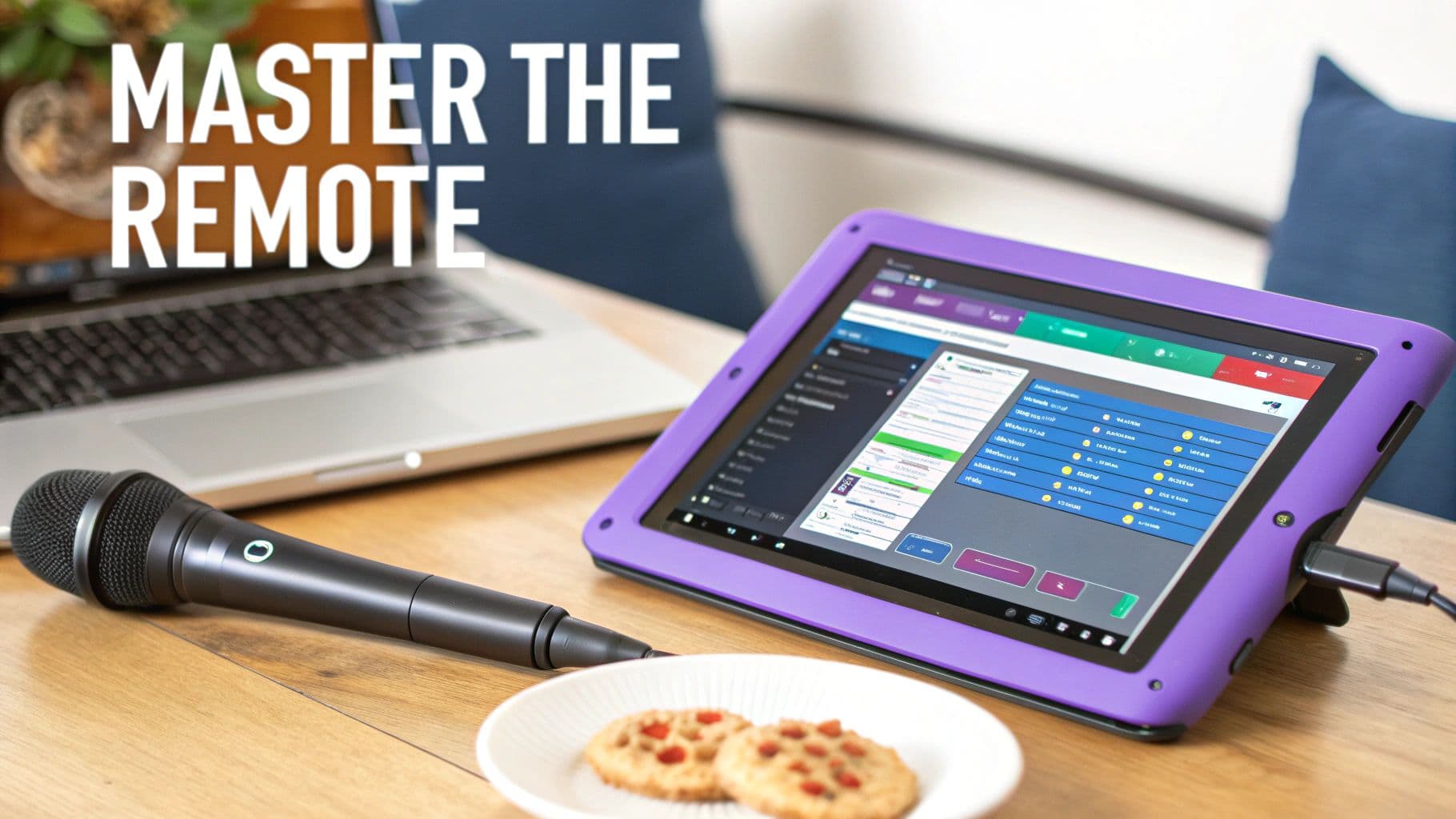
Alright, you're settled in your private room and face-to-face with the heart of the entire operation: the song selection remote. This gadget, whether it's a chunky old-school remote or a slick tablet, is your key to a universe of music.
At first glance, it might look like the control panel of a spaceship with its sea of buttons and Japanese characters, but I promise it’s far more intuitive than it seems. Think of it as your personal DJ booth and sound engineering station all rolled into one. From here, you’ll not only queue up your songs but also fine-tune the audio to make everyone sound incredible. Don't be intimidated—getting the hang of this is the final step to becoming a karaoke pro.
Navigating the Song Selection System
First things first, let's find your anthem. Modern systems in any major Japanese karaoke bar are surprisingly user-friendly, giving you multiple ways to search through a library that often contains hundreds of thousands of songs.
Most devices have a language button, often labeled 言語 or showing a little globe icon. Tap that, and you can usually switch the whole interface to English. Problem solved.
Once you're in a language you recognize, finding a song is a breeze. You can usually:
- Search by Artist: Just type in your favorite band or singer.
- Search by Song Title: The most direct route if you know exactly what you want to sing.
- Browse by Genre: Feeling spontaneous? Take a wander through categories like J-pop, anime, rock, or international pop.
- New Releases & Rankings: See what’s trending in Japan or check out the latest tracks added to the machine.
A killer tip for international visitors: search using romaji—the romanized spelling of Japanese words. Even if you're stuck on the Japanese interface, typing "Arigato" will almost always pull up the song you're looking for.
Fine-Tuning Your Performance
This remote is so much more than just a glorified songbook. It gives you the power to mix the sound on the fly and make you sound like a star. Look for the on-screen controls or physical buttons that let you tweak the audio.
You can almost always control:
- Music Volume (BGM): This adjusts how loud the backing track is.
- Mic Volume: Turn your own voice up or down to get the balance just right.
- Echo/Reverb: This is where the magic happens. Add that classic, stadium-like effect to your vocals for a more polished, professional sound.
- Key/Pitch Control (キー): Honestly, this is a game-changer. If a song is too high or low for your range, you can shift the key up or down until it sits comfortably in your sweet spot.
After you select your song, it goes into the queue, or "yoyaku" (予約). You can stack dozens of songs in the reservation list, making sure there's never an awkward silence. The main TV screen will always show what's playing and who's up next. You can even prioritize a song to jump the line—perfect for capturing that sudden burst of inspiration. If you're curious about the tech behind it all, you can learn more about how karaoke machines work in our detailed guide.
Must-Try Song Categories for Everyone
With a library that feels infinite, the hardest part is often just deciding what to sing. But the beauty of a Japanese karaoke bar is the sheer variety. There’s truly something for every single person in your group, no matter what language they speak.
To get you started, here are a few can't-miss categories for a well-rounded karaoke session:
- Classic J-Pop: Dive into the iconic hits that have defined generations of Japanese music.
- Anime Themes (アニソン): This is an essential part of the experience. Belting out the opening to a famous anime is a guaranteed crowd-pleaser.
- Global Top Hits: You’ll find a massive selection of English-language songs, from The Beatles to Taylor Swift.
- Vocaloid: For something uniquely Japanese, try a song performed by a virtual idol like Hatsune Miku.
- Enka (演歌): If you're feeling particularly bold, give this traditional, dramatic style of Japanese ballad a try. It’s an experience you won’t forget.
Create Your Own Karaoke Videos at Home
So, you just had an amazing night at a Japanese karaoke bar and you're hooked. That feeling of belting out your favorite song is addictive, and it doesn't have to stop when you head home. What if you could take that same energy and make your own custom karaoke videos?
This is where the real fun begins. Imagine turning that obscure J-pop track or anime theme you love into a high-quality video for your friends or even an online audience. Thankfully, you no longer need to be a video editing pro with complicated software. Modern tools let you do it all right in your web browser.
These platforms are built for karaoke fans and creators, giving you everything you need to bring a song to life without the headache.
Bringing the Karaoke Box to Your Browser
The heart of any good karaoke track is perfectly timed lyrics. Getting this right used to be a huge pain, involving hours of manual syncing. Now, smart tools can do the heavy lifting for you. Just upload your audio, paste in the lyrics, and an AI-powered system lines it all up with the music automatically.
It’s like having a digital assistant who handles the most tedious part of the job. This frees you up to focus on what really matters: the creative touches that will make your video stand out.
The whole idea is to give you the polished experience of a high-tech Japanese karaoke system, but with you in the director's chair. You get full control over the look and feel without a steep learning curve.
Once your lyrics are locked in, it's time to get creative and customize the visuals to match the song's vibe.
Customizing Your Video Masterpiece
Here’s where you get to put your own personal spin on things. Just like the themed rooms in a Japanese karaoke bar, the background and text style of your video are what set the mood for the performance.
You can usually tweak all sorts of settings to get it just right. Common features include:
- Backgrounds: Swap out a boring black screen for your own custom images or video clips.
- Fonts and Colors: Pick from a massive library of fonts and color schemes to make the lyrics pop and ensure they’re easy to read.
- Animations: Add cool effects that highlight words or syllables as they’re meant to be sung.
Of course, the lyrics themselves are crucial. Learning how to add subtitles to videos is a skill that will seriously elevate the quality and usability of your final creation. When you’re all done, you can export your masterpiece as a crisp, high-definition 1080p MP4 file, ready for any screen.
Whether you're starting a karaoke channel, making a lyric video for your own band, or just whipping up something fun for a party, these tools make it happen. You can capture that magic from your night out in Japan and share it with the world, one perfectly synced lyric at a time.
Answering Your Top Japanese Karaoke Questions
Even after reading a guide, there are always a few lingering questions before you dive into your first Japanese karaoke experience. Let's tackle some of the most common ones. Think of this as your final prep talk to make sure you walk in ready to grab the mic with confidence.
Do I Need to Reserve in Advance?
It really depends. If you're with a friend or two on a Tuesday afternoon, you can almost always just walk in. But if you've got a bigger crew or you're planning a night out on a Friday or Saturday, booking ahead is a very smart move.
Most of the big karaoke chains have online booking systems on their websites, or you can just give them a quick call.
A quick heads-up: during major holidays like Golden Week or the New Year's season, booking is absolutely essential. Trying to find a room without a reservation during these times is a recipe for disappointment.
Honestly, a simple reservation can save you from wandering the streets looking for a spot and get you straight to the fun part.
How Much Does a Karaoke Bar Cost?
The price of karaoke in Japan can change quite a bit based on when you go. As a rule of thumb, daytime hours are always the cheapest, with prices climbing for evenings and weekends. You're usually charged per person, in 30-minute increments.
For the best bang for your buck, keep an eye out for "free time" (フリータイム) packages. These are a game-changer. They let you sing your heart out for several hours for one flat rate. If you know you'll be there for more than 90 minutes, the "free time" deal is almost always the way to go.
What Is the Basic Group Etiquette?
Here’s the most important thing to remember: Japanese karaoke is all about having fun together, not winning a singing competition. It’s a group activity where the main goal is making sure everyone has a good time.
A few simple pointers will go a long way:
- Share the Mic: Don't be that person who lines up ten songs in a row. Pass the song-selection tablet around and make sure everyone gets their turn to shine.
- Be a Good Audience: When someone else is up, be their biggest fan. Clap when they finish, sing along on the chorus, or shake one of those tambourines they always have in the room. It’s all about a supportive vibe.
- Keep It Positive: No one is expecting a Grammy-winning performance. The whole point is to participate, so cheer on your friends—especially anyone who seems a bit hesitant. A little encouragement can make all the difference.
Ready to create your own karaoke magic? With MyKaraoke Video, you can transform any song into a professional-quality karaoke video in just minutes. Use our AI-powered tools to sync lyrics, customize backgrounds, and share your creations. Start making your own videos today!
